That was the first sentence all day that felt completely true.
In the weeks that followed, nothing became magically easy.
Family court rarely gives anyone a clean ending.
There were interviews.
Evaluations.
New schedules.
Rules about communication.
Lawyers sent careful emails instead of angry calls.
Avery met privately with professionals whose job was to hear her without asking her to choose a parent.
Daniel denied intentionally coaching her.
Eventually his language changed.
He said he had been frightened.
He said he had convinced himself that my emotional responses to our failing marriage proved something larger about my parenting.
He said he had wanted certainty and had pushed too hard to create it.
I never learned how much of that explanation he truly believed.
Maybe all of it.
People do not always experience themselves as villains while they hurt others.
Sometimes they simply become so committed to winning that every fact starts looking like material.
The final custody arrangement came months later.
Daniel did not receive sole custody.
The evaluator recommended substantial involvement from both parents but with strict boundaries against using Avery as a messenger, witness, confidante, or source of information about the other household.
The court adopted those safeguards and warned us both that Avery’s relationship with each parent had to belong to her, not to our case.
It was not everything I once thought justice would look like.
It was better.
Because it wasn’t about humiliating Daniel.
It was about removing Avery from the battlefield.
One afternoon after the case finally settled into its new rhythm, I found the navy cardigan hanging over the back of a kitchen chair.
The pocket sagged slightly where the recorder had once been.
Avery was at the table doing homework, chewing the end of a pencil.
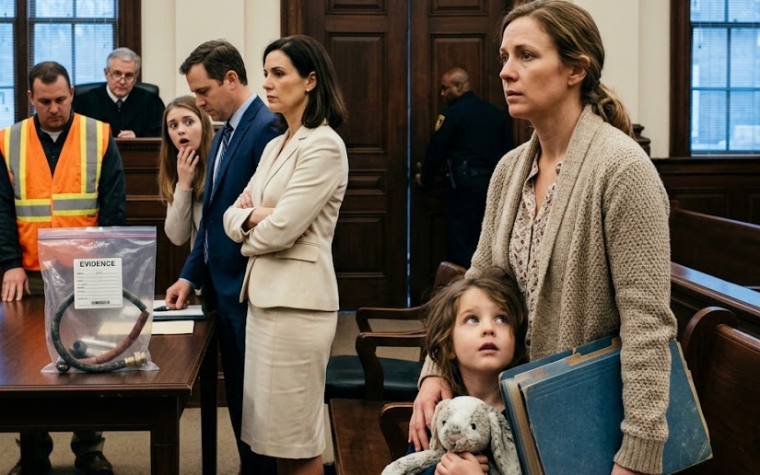
For a moment I remembered her standing in court, knees shaking, asking permission to show everyone something her mother had never seen.
I had spent years believing my professional experience made me good at spotting hidden evidence.
But the most important evidence in my life had been carried into a courtroom by a child in white sneakers.
Not because she wanted to defeat her father.
Not because I had taught her to fight.
Because she had grown tired of being told that the truth needed editing.
I hung the cardigan properly in the hallway.
Then I returned to the kitchen and sat beside her while she worked.
Avery looked up.
“You okay, Mom?”
I smiled.
“Yes.”
And this time, there was nothing behind the answer she needed to decode.