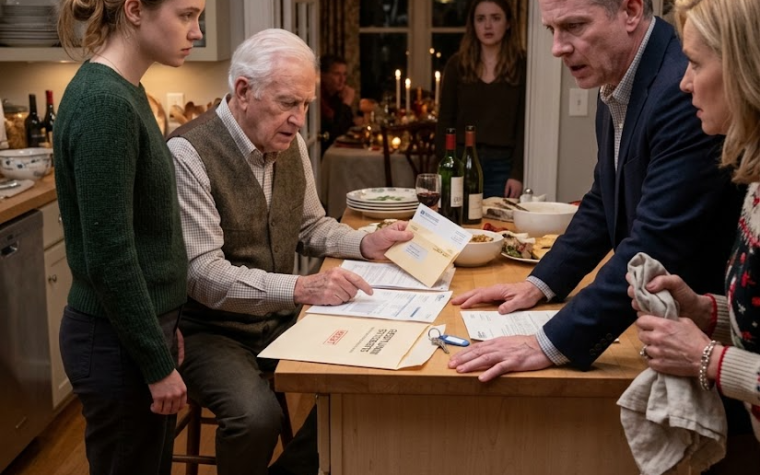
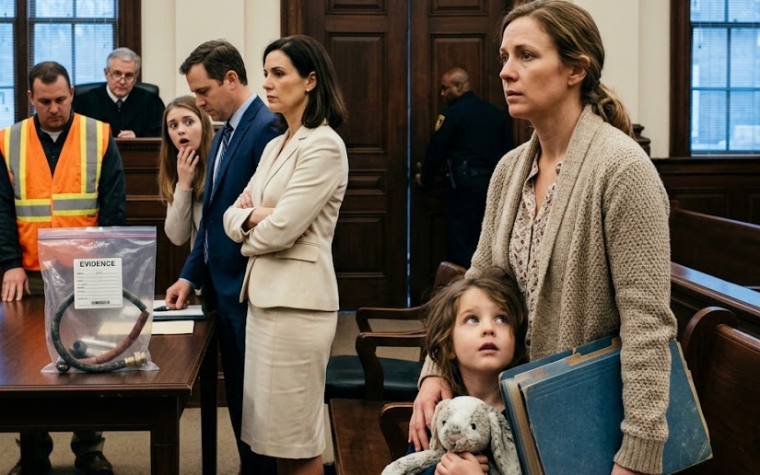
We’re done here.”
He grabbed Max’s backpack.
Then Max said something that stopped him.
“But you said they’d delete it.”
Silence fell over the hallway.
Richard slowly turned toward his son.
Max looked frightened now, but not because of me.
He was looking at his father.
Richard’s voice dropped.
“What are you talking about?”
“The video,” Max said.
“You said not to worry because they’d delete it.”
Richard’s face became rigid.
“I never said that.”
“Yes, you did.”
“Max.”
The boy flinched.
The safeguarding officer stepped between them, not dramatically, but firmly enough to end the exchange.
“We’ll document what was just said,” she told Richard.
He looked at me as though I had somehow arranged the moment.
I hadn’t spoken.
That seemed to make him even angrier.
“This is what you wanted,” he said.
“No.”
I stood from the bench where I had been waiting.
“What I wanted was to take my daughter to school and have her come home safely.”
He had no answer to that.
The consequences did not arrive in one cinematic explosion.
Real accountability rarely does.
It came in paperwork, interviews, meetings, preserved recordings, formal notices, and people who could no longer pretend they had seen nothing.
Oak Creek Elementary opened a full review of how staff had responded to previous complaints involving influential families.
The district required new reporting procedures so donations could not be discussed by administrators handling student discipline.
The principal was investigated for his hesitation and for failing to immediately secure the footage.
Investigators ultimately found that he had been afraid of Richard’s financial influence, though there was no evidence he had actually destroyed or altered anything.
He received formal discipline and mandatory retraining.
He later apologized to me.
More importantly, he apologized to my daughter.
Richard’s check became part of the documented inquiry into whether he had tried to improperly influence the school’s response.
I had no role in deciding what legal consequences, if any, followed.
I formally recused myself from every matter in which my position could create even the appearance of interference.
That frustrated Richard.
He wanted to accuse me of persecuting him.
Instead, he had to answer questions from people I did not supervise and judges who had nothing to do with my family.
His donations could not erase the call records.
His reputation could not cross-examine a video.
And his confidence could not make multiple witnesses forget what they had heard.
Max faced school discipline appropriate for his age and the findings of the investigation.
The district also required counseling and behavioral intervention before he could return to regular activities.
I was glad they did not treat an eleven-year-old as beyond redemption.
What disturbed me most about Max had never been that he was some inherently cruel child.
It was the certainty behind his words.
“My dad funds this school.
People do what we tell them to do.”
Children learn sentences like that somewhere.
For years, Richard had apparently been teaching his son that money did not merely open doors—it removed consequences.
Now Max had seen adults refuse that lesson.