“At home.”
I felt Nora’s hand tighten around mine.
Their lawyer closed his eyes for a moment.
The judge asked my mother whether she had removed the folder from my carriage house.
“No,” she said quickly.
“Not that night.”
“Then how did you get it?”
My mother swallowed.
“A few days later.”
My father stared at her like she had betrayed him.
Maybe she had.
Or maybe she had finally stopped betraying me.
She explained that after the recording was made—without knowing Nora had captured any of it—she returned while I was at work.
She used the spare key my father kept.
She found the blue folder in a storage box beneath my desk and took it to the main house.
She said Ava wanted the signed agreement destroyed.
Ava stood so suddenly her chair struck the floor behind her.
“That is not what I said.”
Her lawyer caught her arm and told her to sit.
My mother kept talking.
“You said if the paper disappeared, Clara couldn’t prove what Dad promised.”
“I said it wasn’t valid!”
“You said to burn it.”
The words hung there.
Ava’s face went white.
My father finally spoke.
“Enough.”
The judge looked directly at him.
“No, Mr.
Morgan.
I don’t believe we are finished.”
She recessed the hearing and ordered the folder brought to court without alteration.
She also warned everyone not to destroy, modify, conceal, or remove any potentially relevant evidence.
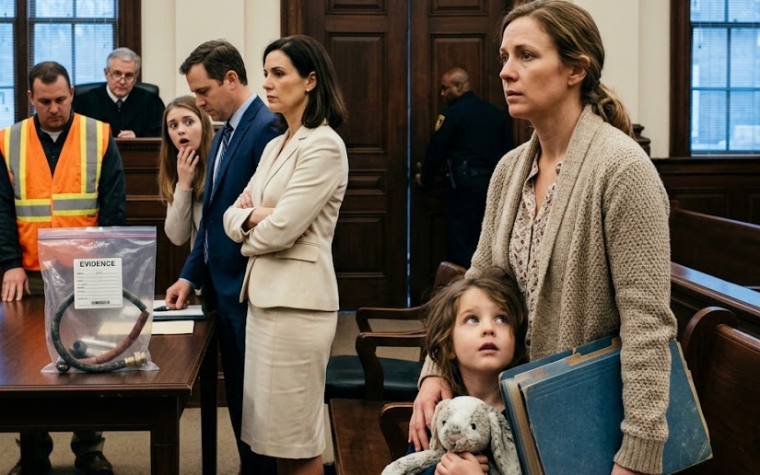
My mother left with a court officer and returned later carrying the blue folder against her chest.
I recognized the coffee stain on one corner.
The sight of it almost made me laugh.
Months of being told I was confused, sentimental, entitled, unstable about the past—and there it was.
A cheap office folder with a bent metal fastener.
The clerk received it.
Inside were construction invoices, notes, permits, and near the back, a three-page agreement dated before ground was broken.
My signature was there.
My mother’s.
My father’s.
And beneath them, as witness, the contractor’s.
The agreement did not magically transfer my parents’ entire property to me.
It did not turn the backyard into a separate parcel overnight.
The language was simpler and, in some ways, more important to the case actually before the court.
It stated that I was funding construction of the carriage house for my and Nora’s exclusive residence; that the structure was being built in reliance on my parents’ promise of permanent occupancy; and that they would not seek to remove me simply to give the residence to another family member after accepting my investment.
There was also a clause requiring reimbursement of documented construction costs under specified circumstances if the arrangement ever ended.
Their attorney read it twice.
Then he asked for another recess.
The judge refused.
He changed tactics instead.
He argued that the document was informal, that it did not convey title, that circumstances had changed, and that my parents still owned the land.
Some of that was true.
But it was not the clean eviction story he had presented that morning.