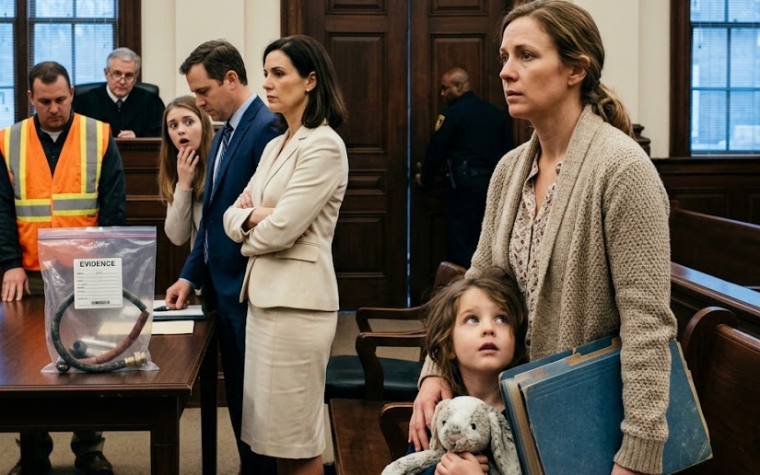
“You’re really going to destroy this family over a backyard house?” she asked.
I stared at her.
“I built that house.”
“You can build another one.”
There it was.
The sentence that finished what the petition had started.
To Ava, my skill had become an argument for taking from me.
Because I could recover, I was the safest person to hurt.
I looked at my father.
He said nothing.
My mother came through the doors last.
She stopped several feet away.
“I’m sorry,” she said.
Ava rolled her eyes.
My mother ignored her.
“I should have given you the folder the day I took it.”
“Yes.”
“I was afraid of your father.”
I did not tell her that fear erased what she had done.
It didn’t.
But I believed her.
That mattered less than it once would have.
The case did not disappear that afternoon.
Real disputes rarely end with one perfect sentence and a gavel.
Lawyers exchanged documents.
The contractor gave a formal statement confirming he had witnessed the agreement.
My bank records matched the construction invoices.
Permit records showed my involvement from the first application through final inspection.
Utility records showed that Nora and I had treated the carriage house as our established home for years.
My parents eventually withdrew the eviction petition.
The larger property dispute was resolved through a written settlement after months of negotiation.
I kept the right to remain in the carriage house under enforceable terms, and the money I had invested could no longer be dismissed as a casual gift.
Any future sale or transfer affecting the property had to account for the agreement and my documented financial interest.
Ava never moved in.
For a while, she stopped speaking to me entirely.
My father communicated only through lawyers.
My mother sent messages I sometimes answered and sometimes did not.
I learned that restored dignity does not always look like reconciliation.
Sometimes it looks like changing the locks.
I replaced every exterior lock the week after court.
The contractor came back to fix the sticking window.
When he finished, he stood in Nora’s little reading nook and smiled at the shelves he had installed years earlier.
“Still her castle?” he asked.
Nora, sitting cross-legged with a book, nodded.
“Obviously.”
He laughed.
After he left, I found Nora at the kitchen table drawing houses.
Not princess castles this time.
Real houses.
Tiny floor plans with doors, windows, kitchens, and absurdly large bedrooms for seven-year-olds.
She looked up at me.
“Are we staying?”
I pulled out the chair beside her.
“Yes.”
“For forever?”
I thought about promises.