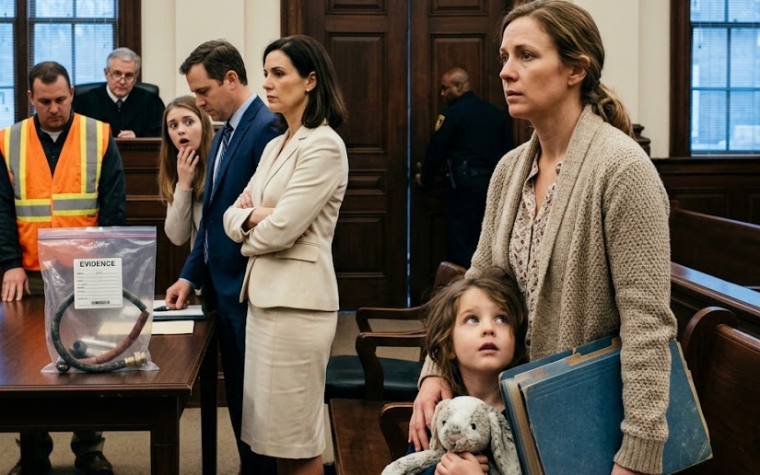
“Miguel, let me handle this.”
Dad pulled away.
The movement was small, but I saw it.
So did the judge.
For weeks, my father had repeated Navaro’s version of events as if repetition turned suspicion into memory.
I had supposedly hovered over my mother during her final months.
I had supposedly isolated her.
Pressured her.
Used my position to make her afraid of resisting me.
But dates do not become intimidated because someone raises his voice.
On days Navaro’s filings placed me inside my mother’s house, my service record placed me elsewhere under documented military orders.
On other days, my access logs showed I had been working through official channels hundreds of miles from the conversations he claimed occurred in person.
The story was not merely exaggerated.
Parts of it were physically impossible.
My father stared at me.
“You never told me.”
I met his eyes.
“You never asked where I was.”
His mouth opened, then closed.
That sentence hurt him more than I intended, probably because it was not dramatic.
It was simply true.
For years, he had built explanations for my absences without asking what my work required.
When I came home tired, he called me distant.
When I could not discuss an assignment, he called me secretive.
When I refused to argue, he called me arrogant.
He had spent so much time defining me that he had never needed to know me.
Judge Wexler turned to the recording.
“Mr.
Navaro, yesterday you represented this audio as evidence that Ms.
Reyes was discussing her mother’s estate.”
“That was the reasonable implication.”
“That was not my question.”
His confidence slipped another inch.
“Do you possess the unedited recording?”
He hesitated.
My father saw it.
That was the exact moment the case changed.
Not when the judge recognized Navaro’s name.
Not when my service dates contradicted the allegations.
It changed when my father finally watched his own lawyer hesitate.
“I received an excerpt,” Navaro said.
“From whom?”
“I am not at liberty to disclose that without—”
“You introduced it as evidence in this court.”
Judge Wexler’s voice remained quiet.
“You do not get to claim secrecy after using protected material to accuse another person of misconduct.”
She ordered the courtroom clerk to mark the recording for forensic review and directed that no copies leave the court’s control.
Navaro objected twice.
Both objections were denied.
Then the judge asked the question I had been waiting for.
“What was the actual context of the conversation, Ms.
Reyes?”
I stood.
“My mother was receiving treatment through a military-connected hospital system because of coverage available through my service status.
She was exhausted by repeated administrative calls.
When I said, ‘I’ll take care of it,’ I was referring to paperwork and scheduling.”