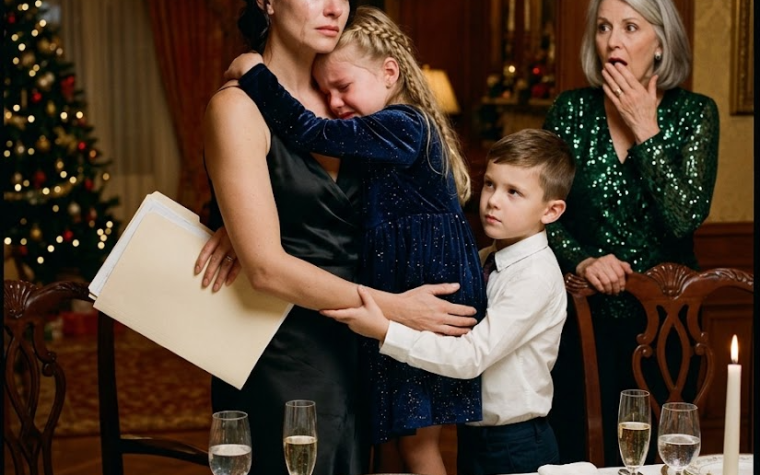
That distinction became important because anger can make innocent people convenient targets.
My case was about the marriage Julian and I had made, the promises he had broken, and the finances he had handled while believing I would never examine them closely.
The process was not instant.
Nothing meaningful was settled by one dramatic social-media post.
There were documents to exchange, explanations to challenge, accounts to review, and uncomfortable conversations among people who had trusted Julian professionally and personally.
But the balance had changed.
Before March 15, Julian controlled information.
After March 15, information controlled him.
The financial review established enough discrepancies to force a serious accounting of the disputed transfers.
Money that I had feared was simply gone became part of the divorce negotiations instead of disappearing behind Julian’s explanations.
Records were preserved.
The movement of funds was documented.
My claim to the assets that belonged within the marriage could no longer be ignored merely because Julian had assumed control of them.
He did not lose everything overnight.
I did not magically receive some enormous fortune.
Real consequences were slower and less theatrical than that.
But he had to answer questions he once believed no one would ask.
He had to explain transactions.
He had to acknowledge the affair in a process where denial no longer served him.
And he had to face the fact that the wife he had dismissed as passive had spent six weeks building a record while he thought she was still waiting for him to come home.
Weeks later, Julian asked me during one of our necessary conversations why I had gone to Paris.
There was bitterness in his voice when he said it.
He had apparently spent days imagining that I had another man waiting there, perhaps because betrayal was the only language he understood well enough to imagine someone else speaking it.
I told him the truth.
“I went to understand where our money went.”
There was a long silence.
That was the moment I knew the divorce papers had never been what frightened him most.
He had seen those papers and believed they represented the end of a marriage he had already abandoned emotionally.
But the folder represented accountability.
It meant I knew where to look.
It meant other people knew where to look.
It meant walking away from me would not erase what he had done while I was still his wife.
In Paris, I began sleeping through the night again.
At first, the quiet felt unnatural.
I had become so accustomed to listening for Julian’s key in the apartment door that part of me still expected to hear it even thousands of miles away.
I would wake and reach for my phone before remembering there was no explanation I needed from him anymore.
The answer had already arrived at Gate B23.
A photograph of Julian outside Natalia’s delivery room had looked, for four terrible minutes, like the worst thing that could have happened to me.
It wasn’t.
The worst thing had been the years before it—the slow shrinking of myself inside a marriage where I kept mistaking endurance for loyalty.
The photograph simply ended my ability to pretend.
Months later, when the financial disputes had been addressed and the divorce moved toward its conclusion, I looked again at the picture from the hospital.
I expected it to hurt.
Instead, I noticed the watch on Julian’s wrist.
The anniversary gift I had once chosen carefully because I wanted him to carry some piece of our life everywhere he went.
There it was, shining beneath hospital lights while he waited for another woman’s child to be placed in his arms.
For a long time, I thought that image proved how completely I had been fooled.
Eventually, I saw something else.
It proved that evidence arrives in ordinary forms.
A photograph.
A hotel reservation.
A transfer.
A message.
A hospital form.
A folder carried through an airport.
None of those things saved me by themselves.