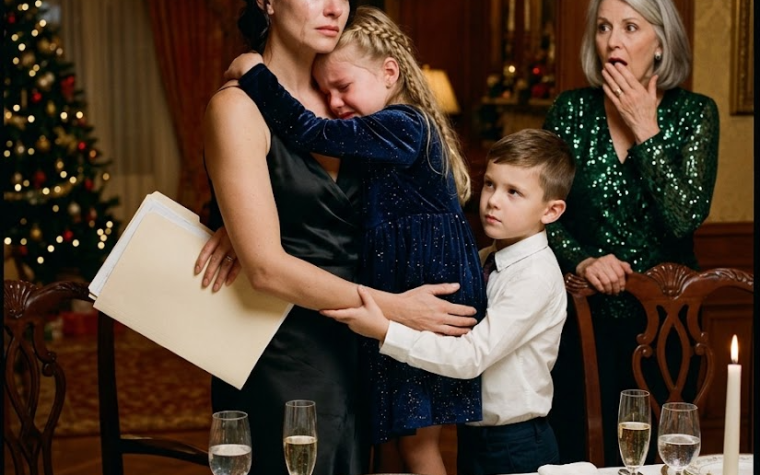
I almost laughed at the cruelty of the question.
Only hours earlier, she had ordered me out with one suitcase and no concern about where I would sleep.
Now that the uncertainty belonged to her, it had suddenly become unbearable.
“You should have considered that before telling the owner to leave,” I said.
Her eyes filled, but the tears did not soften me the way they once had.
I had seen her cry whenever consequences approached, then recover as soon as someone else agreed to carry them.
“You planned this,” she said.
“I prepared for it.
There is a difference.”
“You wanted to humiliate us.”
“No.
I wanted you to stop taking from me.
You chose to make that impossible without witnesses and documents.”
Marissa snatched the notice from her hand.
“She cannot do this.
We live here.”
My lawyer pointed to the contact information at the bottom.
“You may challenge the notice through the proper process.
Until then, I recommend that you do not remove, sell, damage, or conceal any property belonging to my client.”
Marissa looked toward the bare living room.
“What property? She already took everything.”
“Not everything,” I said.
I held out my hand.
“My car key.”
She stared at me.
The car they had driven home in was registered in my name.
My mother had persuaded me to let Marissa use it for one afternoon months earlier.
After that, the key had simply stopped coming back.
“She needs it for work,” my mother said.
“So do I.”
“You have another way to get around.”
“That does not make the car hers.”
Marissa reached into her coat pocket and clenched her fist around the key.
“You cannot strand me.”
“You drove my car here after telling me not to return to my own house.”
“That was different.”
“Because you believed I would accept it?”
She looked at my mother again.
This time, my mother did not defend her.
She seemed to be calculating what else might appear from the folder.
Slowly, Marissa placed the key in my palm.
The metal was warm from her hand.
I closed my fingers around it.
My mother lowered herself onto one of the sealed boxes because there were no chairs left.
She looked smaller without the dining table between us, without the photographs and furniture that had made her feel permanent.
“What do you want?” she asked.
It was the first real question she had asked me all night.
“I want every item returned.
I want the cash accounted for.
I want the watch recovered.
I want you both to stop entering my room, using my car, and promising away property that is not yours.”
“And then?”
“You follow the notice.”
Her face twisted.
“So there is no forgiveness.”
“Forgiveness is not the same as continued access.”