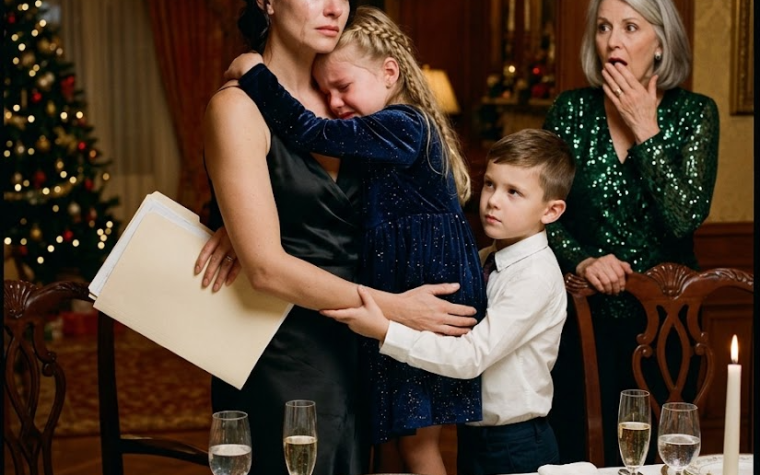
“She should have given me the folder.”
There it was.
Not remorse.
Not fear for Sophie.
The folder.
The evidence.
I stood.
“We’re done.”
The legal process did not produce the kind of instant revenge people imagine in stories.
It took documents, interviews, disputed claims, negotiations, and investigations.
Some matters were resolved faster than others.
But the central truth became impossible to bury.
I had not authorized the broad control Richard claimed.
The transactions involving my accounts and property were challenged and unwound where legally possible.
The house was restored to my control after the disputed transfer was addressed.
Funds that could be traced were recovered or became part of claims against the company and responsible parties.
Richard lost the unquestioned authority he had spent years building.
His business faced scrutiny from people whose trust had depended on the accuracy of his records.
His relationship with me did not survive what those records showed.
Rebecca tried several times to convince me that separating from them was cruel.
I reminded her of the view from her living-room window.
Emily in the snow.
Sophie under a thin coat.
My mother had seen them.
And she had stayed inside.
That was the part no contract could explain away.
Months later, Emily and I stood on the same porch on a clear morning.
The winter storm was gone.
Sophie was bundled properly this time, warm and alert in my arms.
Emily held a new key.
We had replaced the locks ourselves.
Not because we were afraid my parents would return, but because the old lock had come to represent something I no longer wanted in our home: permission handed to people who believed trust meant ownership.
Emily slid the key into the door, then stopped.
“You know,” she said, “I kept thinking you would blame me.”
“For what?”
“For not seeing it sooner.
For taking the folder.
For making everything explode.”
I looked at her.
“You didn’t make it explode.
You found the smoke.”
She smiled for the first time that morning.
Inside, the marble floor still showed no trace of the melting snow I had tracked across it the night I returned.
But I remembered every step.
I remembered carrying my wife past my parents while Sophie cried against my chest.
I remembered my father’s certainty that everything belonged to him.
I remembered my mother’s outrage over wet floors while her granddaughter was struggling to stay warm.
For eighteen months, I had believed coming home meant returning to the place I had left.
I was wrong.
Home was never the chandelier, the marble, the company name, the accounts, or the property deed.
Home was Emily asleep beside Sophie after surviving a night neither of them should have endured.
Home was the woman who kept one black folder when powerful people ordered her to surrender it.
Home was the daughter whose weak cry in the snow had stripped every illusion from me in a single second.
My parents had taken money.
They had tried to take property.
They had used my absence as leverage and my trust as an opening.