Before dawn, the trust administrator responded to the server alert.
All pending changes involving our accounts were frozen.
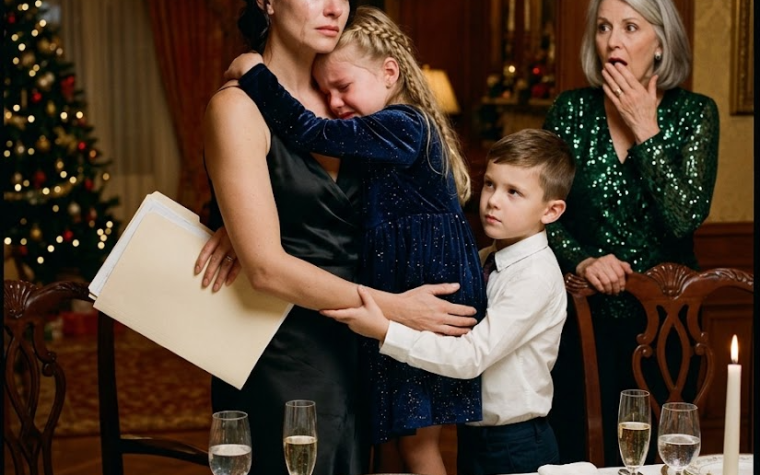
Copies of the guardianship papers, medical evaluations, and transfer instructions were secured for review.
Arthur had spent months arranging signatures and influence.
One emergency phrase stopped every transaction.
The forged medical history collapsed quickly.
Several evaluations described appointments that had never occurred.
One report claimed I displayed violent behavior on a date when school records placed me at an academic competition.
Another stated Clara could not distinguish reality from imagination, yet the supposed examining physician had never met her.
The signatures were convincing to ordinary eyes.
They were less convincing to investigators who knew what to compare.
Our father had taught us that fraud rarely depended on one perfect lie.
It depended on people being too intimidated, hurried, or ashamed to examine a collection of imperfect ones.
Arthur had intimidated hospital employees.
He had hurried the guardianship process.
He had counted on our shame.
The recordings joined those imperfect lies together.
Over the next several days, investigators reviewed three months of files.
They heard Arthur planning to isolate us after our eighteenth birthdays.
They heard Margaret discussing which relatives and teachers should be told we were unstable.
They heard them calculate how quickly trust assets could be transferred into companies Arthur controlled.
They also heard the nights when Arthur hurt us.
Some recordings contained only sounds: a door locking, Clara pleading, furniture scraping, Arthur ordering us not to cry loudly enough for the household staff to hear.
Those were the hardest files to confirm.
Clara asked that they stop playing one during her interview.
No one forced her to continue.
That simple mercy made her cry harder than the recording had.
We were moved from the emergency department to a protected hospital floor.
A court temporarily removed Arthur and Margaret’s authority over our medical decisions.
Until we turned eighteen, an independent guardian supervised our care and contact.
Arthur filed an emergency petition claiming I had manipulated Clara and fabricated evidence to gain early access to the trust.
The petition included one of the forged evaluations.
By then, the physician whose signature appeared on it had submitted a sworn statement saying the document was false.
The court denied Arthur’s request.
At the protective hearing, Margaret tried to separate herself from him.
She described years of fear.
She said Arthur controlled the money, the house, and her choices.
She insisted that cooperation had been the only way to keep us alive.
Part of me wanted to believe her.
Then the prosecutor played a recording made twelve days before the attack.
Arthur had suggested delaying the scheme because the trust administrator was asking questions.
Margaret answered, “No.
Once the girls turn eighteen, Eleanor will remove us from the house.
We finish this now.”
There was no fear in her voice.
There was resentment.
When the recording ended, Margaret looked at me as if I had betrayed her by surviving long enough to hear it.
Clara leaned toward the microphone at the witness table.
“You had choices,” she said.
“You just never chose us.”
Margaret lowered her eyes.
Arthur never apologized.
He challenged the recordings, the doctors, the police, and eventually his own attorneys.
He claimed the files had been edited.
Digital specialists verified the upload history, device identifiers, timestamps, and protected copies.
The server’s automatic logging showed that the files had accumulated over months, not been created after the attack.