During a final private visit to Germany, Gerhard showed him the concealed channel behind bracket GM04, originally designed to hold a racing emergency tag.
Charles realized the car could become a vault that Preston would underestimate.
Preston knew Charles hid records somewhere.
He had searched offices, storage rooms, and the Manhattan box.
When he discovered references to the Porsche in an old calendar, he arranged the secret repair.
His technicians found the bracket but not Gerhard’s latch.
They replaced the bypass cover after damaging it, then deliberately restricted the new part to force repeated shop visits.
Each failure gave them another excuse to open the engine without alarming Sophie.
They had almost reached the capsule.
Then Dr.
Richard Calloway recommended Walker Motor Works.
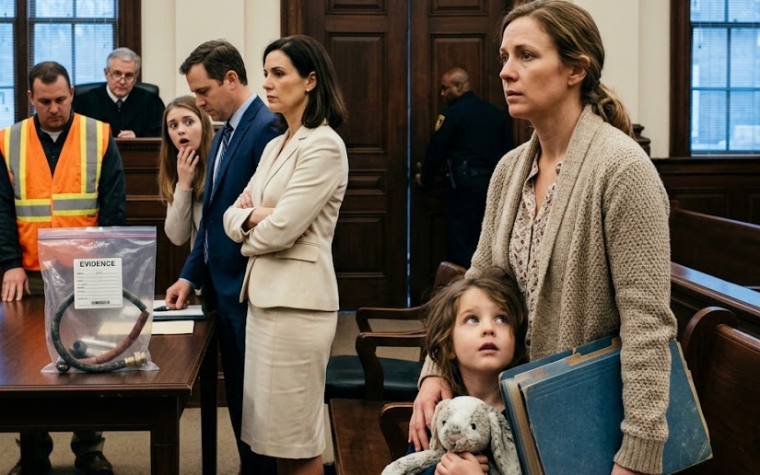
By seven that evening, the evidence-preservation order was signed.
Preston’s phone was surrendered.
Messages recovered later showed that at 11:52 that morning—five minutes after I opened the Porsche—he had texted the New Jersey restoration company.
“He found the bracket.
Delete everything.”
The owner had replied, “What about the card?”
Preston’s answer contained two words.
“Get it first.”
That message ended his denials.
He left the estate through a side door with his lawyer, no longer smiling, while photographers gathered beyond the gates.
Sophie did not watch him go.
She remained beside the Porsche, one palm resting on the roof her father had once polished by hand.
The next morning, Archer Capital’s board removed Preston from every position pending investigation.
The forged proxy was invalidated.
Independent trustees assumed temporary control while regulators and federal investigators reviewed the transactions.
The process lasted months rather than hours.
Money did not leap back into accounts because the truth had been found.
Shell companies fought subpoenas.
Former allies developed selective memories.
Preston claimed Charles had fabricated the recordings during a paranoid decline.
But the recordings matched bank records.
The bank records matched board drafts.
The board drafts matched messages from Preston’s phone.
And the tool marks on the Porsche matched equipment seized from the restoration company.
Metal, paperwork, and voices told the same story.
Preston was eventually charged with wire fraud, forgery, obstruction, and conspiracy.
Several associates accepted plea agreements.
Civil judgments returned controlling shares to the Archer family trust and recovered most of the diverted assets, though not all of them.
Sophie could have hidden the scandal to protect the Archer name.
Instead, she released the independent investigation to investors and admitted publicly that the firm’s governance had failed under her watch.
She resigned from two committees, rebuilt the board, and placed the recovered voting shares into a structure that no single executive—including herself—could secretly control.
She did not restore her empire by pretending she had never been deceived.
She restored it by making deception harder.
As for the Porsche, I rebuilt the oil system using Gerhard’s original specifications.
The authentic bypass cover was located in a locked cabinet at the New Jersey shop.
Its edge had been cut, but the damage was repairable.
Three months later, Sophie came to Walker Motor Works to hear the engine run.
My daughter Emma sat at the front-office desk doing math homework while Sophie stood between my tool cabinets in jeans and an old navy coat.
Without the assistants, estate, and polished audience, she seemed less like an heiress and more like a woman trying to decide what part of her life still belonged to her.
I turned the key.
The flat-six caught immediately.
The idle settled into the crisp mechanical rhythm I remembered from Germany.
Sophie closed her eyes.
“That’s how it sounded when I was little,” she said.
“Engines remember,” I told her.