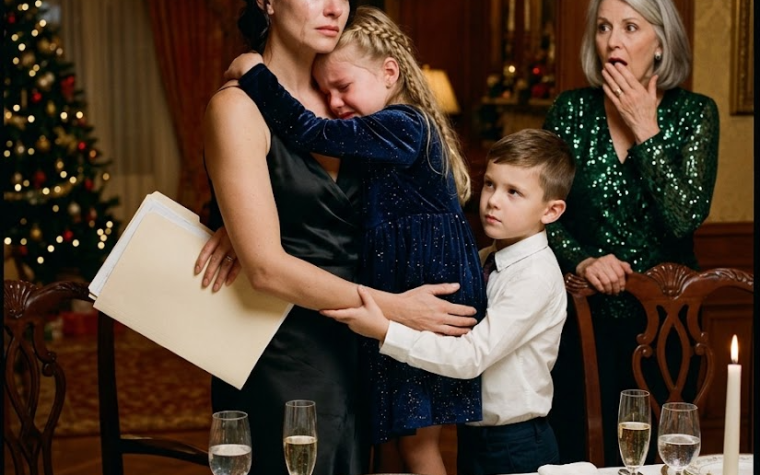
Neither could explain why Vivian said she had been left to “clean up” Adrian’s disaster.
Their attorneys tried to suppress the recordings and discredit Martin.
They suggested I had manipulated the situation because of marital resentment.
They described me as obsessive, suspicious, and vindictive.
Those words had once hurt me.
In court, they sounded like praise.
I had been suspicious.
That was why I photographed the policy.
I had been obsessive.
That was why I saved the messages and traced the withdrawals.
I had been vindictive enough to press a button instead of dying quietly beneath a pillow.
I testified from a wheelchair with a brace supporting my spine.
Vivian sat at the defense table in a dark suit without her pearls.
Adrian sat several feet away behind a separate attorney.
They did not look at each other.
The prosecutor played the ICU recording once.
No one in the courtroom moved while Vivian’s voice filled the room.
“You should have died in the fall.”
The jurors heard the pressure in my breathing.
They heard her promise to finish the job.
They heard the button click and the door open.
Then they heard the corridor recording.
“You were the one behind her.”
“Because you lost your nerve.”
“I never meant for her to survive the balcony.”
The defense could argue about paperwork and motives.
It could not argue with their own voices.
Vivian was convicted for the attack in the hospital and for her role in the balcony fall.
Adrian was convicted for participating in the plan, canceling the repair, concealing financial evidence, and helping create the conditions that nearly killed me.
Their sentences were delivered on different days.
I attended neither hearing.
By then, I had learned that watching punishment was not the same as healing.
My recovery took longer than the trial.
The full-body cast came off in stages.
I spent months relearning movements I once performed without thought—sitting upright, transferring into a chair, standing between parallel bars, taking one step without folding under pain.
Some mornings, the smell of floral perfume pulled me back into the ICU.
A white pillow in the wrong position could make my pulse race.
But fear became something I could name instead of something that owned the room.
I divorced Adrian before sentencing.
I kept none of the Hale family possessions Vivian had once used to measure my worth.
I returned the silver, the monogrammed luggage, the crystal glasses, and every photograph in which Adrian stood beside me while looking somewhere else.
On the final document, I restored my name.
Elena Cross.
The name Vivian had pronounced like an insult became the first thing I reclaimed.
A year after the ICU attack, I visited Martin’s office.
I was walking with a cane by then.
He still had the original folder locked inside an evidence cabinet, its edges worn from the number of times attorneys had examined it.
He placed the small black button on the desk between us.
The plastic was scratched.
A strip of medical tape still clung to one side.
“That little thing changed everything,” he said.
I picked it up.
It had not made me brave.
It had not created the evidence or exposed the money.
It had only given the truth a door through which to enter.
Vivian had believed power meant pressing down harder when someone could not fight back.