And we ask the court to protect Ethan, not the money.
That’s the distinction we want clear from the beginning.”
For the next several weeks, our lives filled with papers.
Karla followed through on her threat.
She filed for custody and authority over Ethan’s financial affairs.
Mr.
Mendez responded by asking the court to recognize the reality Ethan had lived for eleven years: I had been his consistent caregiver, and removing him suddenly would be destabilizing and contrary to his wishes.
The money was handled separately.
Because Ethan was still a minor and the amount was substantial, the court required safeguards around the funds while the dispute continued.
Neither Karla nor I was allowed to simply withdraw millions at will.
I was relieved.
I had never wanted control of Ethan’s money.
I wanted Ethan safe.
That difference became important.
Karla hated it.
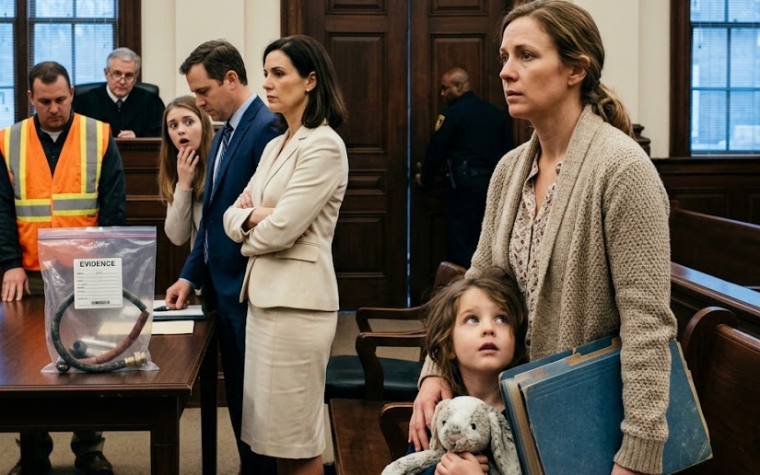
At the first serious hearing, she arrived dressed in dark blue with her hair pulled back, looking more like the grieving mother she wanted the court to see than the woman who had entered my home in red lipstick demanding account access.
Her lawyer described her as a woman who had suffered during her youth and had been “separated from her child by complicated family circumstances.”
Then Karla testified.
She said she had always loved Ethan.
She said I had gradually pushed her out.
She said she had stayed away because she believed I would not allow contact.
Mr.
Mendez did not attack her.
He simply began asking dates.
“What school did Ethan attend when he was eight?”
She didn’t know.
“Who was his pediatrician?”
She didn’t know.
“What year did he begin wearing headphones regularly to manage sensory overload?”
She didn’t know.
“What food does he refuse to let touch rice?”
She stared at him.
I lowered my eyes.
Beans.
For eleven years, I had cooked them on opposite sides of his plate.
Mr.
Mendez placed the original abandonment note into evidence.
Karla’s attorney objected to the interpretation of it.
Then came the recording from my living room.
Not every portion was admitted or relied upon in the way Ethan imagined when he pressed the button, but enough of Karla’s own statements became part of the larger record through testimony and questioning.
Most damaging was the contradiction she could not explain.
She had first implied the abandonment note was false.
Then, while arguing in my home, she had admitted writing it because she was “upset.”
The judge asked her directly:
“Did you leave your five-year-old son with your mother and write, ‘I can’t handle him.
You take care of it’?”
Karla looked at her lawyer.
There was nowhere left to hide.
“Yes.”
My hands clenched together beneath the table.
The judge continued.
“How soon after leaving did you attempt to resume care?”
Karla hesitated.
“I needed time.”
“How much time?”
Silence.