“Because it was true.”
My father rubbed a hand over his mouth.
“We are not reopening something from years ago.”
“You never opened it in the first place,” I said.
“You heard her cry, and you made your decision.”
Diane stared at the floor.
Bianca turned on her.
“Say something.”
Diane’s fingers tightened around her pale blue clutch.
“Diane,” my father said quietly.
She looked older than she had an hour earlier.
“I saw the glass tip,” she whispered.
Bianca became completely still.
My father frowned.
“What?”
Diane swallowed.
“That night.
I came into the dining room before you did.
Bianca was holding the wineglass over the dress.”
The air seemed to leave the room.
My father stared at his wife.
“You told me you didn’t see anything.”
“I said I wasn’t there when it happened.”
“You were.”
“I was afraid.”
“Of a sixteen-year-old girl?” Julian asked.
Diane looked at Bianca.
“No,” she said.
“Of what Bianca would do if I contradicted her.”
Bianca’s mouth opened.
For once, no sound came out.
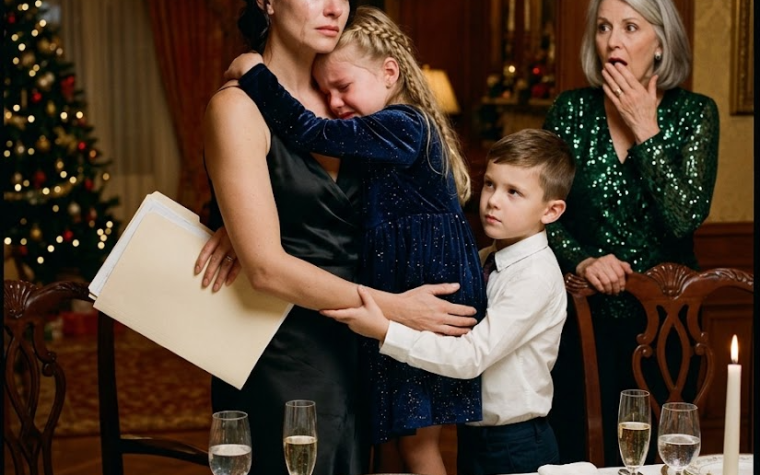
I remembered Diane at that dinner, sitting very straight while my father ordered me from the house.
I remembered waiting for her to speak.
She had known.
All those years, she had known.
My father turned toward me, horror slowly replacing confusion.
“Amelia—”
I held up one hand.
He stopped.
There are apologies people offer because they understand the damage.
Then there are apologies they reach for because witnesses have finally seen them clearly.
I could not yet tell which kind his would be.
Bianca found her voice again.
“She’s lying,” she said.
“Mom, tell them you’re confused.”
Diane’s eyes filled with tears.
“I’m not confused.”
“You always take her side.”
The accusation was so absurd that several guests shifted uncomfortably.
Diane looked at me, then back at her daughter.
“No.
I never did.
That is the problem.”
Bianca stepped away from her as if she had been struck.
Julian removed the white flower pinned to his lapel and placed it beside the folder.
Bianca noticed the gesture.