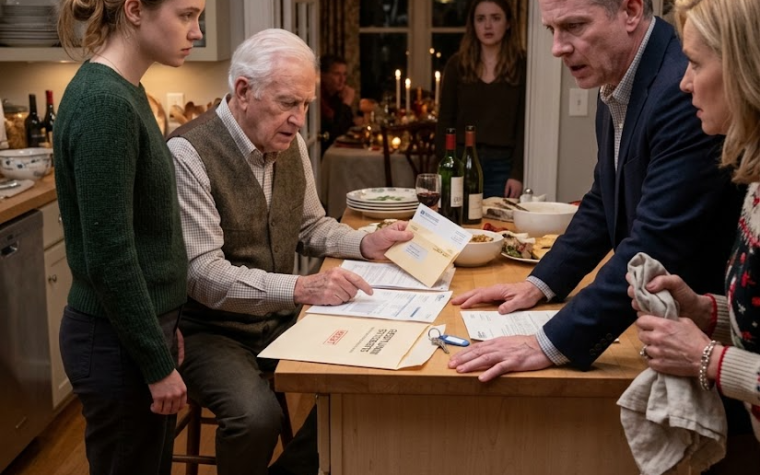
There were, however, records.
Within forty-eight hours, federal filings became public.
Victor Vale’s companies had used layered lenders to hide control over distressed family businesses, then forced personal favors, inflated terms, and vendor kickbacks under threat of immediate ruin.
Mara’s case was not the whole investigation.
It was the door that finally opened.
My parents’ company entered court-supervised restructuring.
It hurt.
They sold a warehouse they loved.
They cut salaries at the top before they touched payroll.
They apologized to employees for the uncertainty and did not hide behind pride.
But they did not lose everything.
Victor lost the thing he loved most: the belief that every room would eventually obey him.
His assets were frozen pending proceedings.
Contracts he had used as weapons were reviewed.
Former partners spoke once they realized silence would not protect them.
The man who had smiled at our dinner table while measuring my sister’s fear began appearing in court in the same gray suit, no silver tie, no champagne glass, no private empire at his back.
Elian tried to call Mara from different numbers until a protective order made every attempt another line in another file.
His charm lasted exactly as long as consequences stayed theoretical.
After that, he became sloppy, bitter, and small.
He denied hurting her, then blamed stress, then blamed his father, then claimed Mara had misunderstood love.
Mara listened to none of it.
The gown stayed at the boutique for three weeks because none of us could bear to pick it up.
When we finally did, the seamstress had wrapped it carefully in plain paper.
Mara stood in the fitting room where I had first seen the marks and touched the sleeve.
‘I hate that dress,’ she said.
‘Then we do not keep it.’
She looked at me.
‘It was expensive.’
‘So was staying silent.’
For the first time in days, she laughed.
It was small.
It broke in the middle.
But it was real.
She donated the dress to a theater program that promised to remove every bridal detail and turn it into something else.
Mara liked that.
Not destroyed.
Transformed.
Months later, our parents hosted dinner in the same dining room where Victor had once lifted a glass to family.
The company was still fragile.
Mara was still healing.
Court dates still appeared on calendars like storms on a horizon.
But our mother laughed while carrying plates.
Our father asked Mara whether she wanted the window open.
He asked instead of deciding for her.
That mattered.
Mara sat beside me, barefoot under the table, hair loose, no ring on her finger.
At one point she leaned her shoulder against mine.
‘When you said we would not cancel it,’ she said, ‘I thought you were choosing the company.’
I looked at her.
‘I was choosing the room where they felt safest.’
She nodded slowly.
The silence after that was not like a courtroom before a verdict.
It was softer.
It was the sound of a family learning to breathe without permission.
Mara reached for the bread basket, smiled at our mother, and kept her back straight.
Not because nothing had happened.