“I spent years making decisions in a military field hospital while people were bleeding, frightened, and far from home,” I said.
“I can understand a deed at my own dining table.”
My son flinched at the words military field hospital.
He knew about my service, but only in fragments.
He had seen the medal once when he was a child.
He had asked whether it belonged to his father, and I told him it was mine.
After that, I returned it to the drawer and rarely mentioned it again.
I had never wanted my courage to become a story I used to demand admiration.
But their ignorance had hardened into an accusation that I had never built anything, never endured anything, and never been capable of standing on my own.
My daughter-in-law folded her arms.
“Being a nurse decades ago has nothing to do with this house.”
“You are right,” I said.
“The deed has something to do with this house.
The closing statement has something to do with it.
The money I transferred has something to do with it.
My service only explains why shouting at me will not make me panic.”
One of my son’s colleagues looked away to hide a reaction.
My son saw it.
His humiliation finally became visible, and for the first time that evening, he directed his anger toward me without disguise.
“You invited these people to watch you destroy me.”
“I did not invite them,” I said.
“You did.
I served the dinner you ordered me to cook.”
His mouth opened, but no answer came.
From the hallway, I heard a small movement.
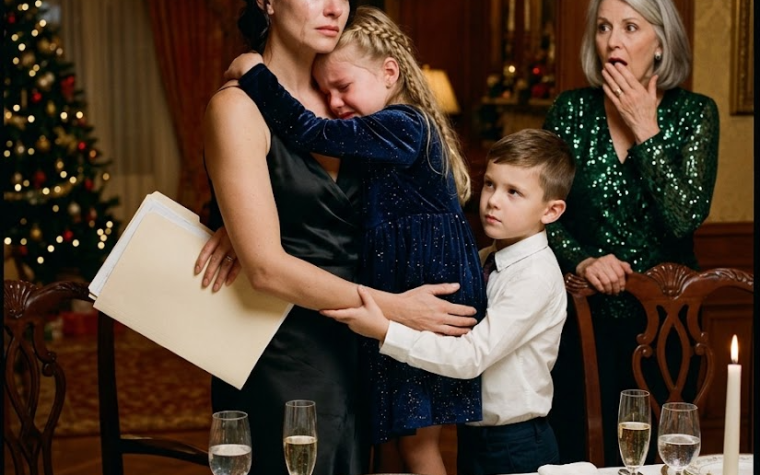
My granddaughter stood near the stairs clutching the railing, awakened by the raised voices.
I rose immediately.
My daughter-in-law moved as though to block me, but I passed her without touching her.
I knelt in front of the child.
“This is an adult conversation,” I told her softly.
“You did nothing wrong.
Go back to your room, sweetheart.”
She looked from me to her mother.
“Are you leaving?”
The question was so quiet that every adult heard it.
I brushed the hair from her forehead.
“I am making sure no one gets to decide that I do not belong.”
She nodded uncertainly and climbed the stairs.
When I returned to the table, my daughter-in-law’s expression had changed.
The contempt remained, but fear had entered beneath it.
“You have nowhere else to go,” she said.
She intended the sentence to weaken me.
Instead, it revealed the assumption beneath all their cruelty.
They believed I remained because I lacked options.
They had never considered that I stayed because I loved them.
I removed my pension statement from the folder and placed it beneath the deed.
“I have enough to live independently,” I said.
“I always have.”
My son picked up the statement, scanned the first page, and slowly lowered it.
The amount was not a fortune, but it destroyed the image they had built of a helpless woman clinging to their generosity.
My savings were intact.
My pension was reliable.
My contribution to the house had not been my last desperate dollar.
My daughter-in-law stared at my son.
“You told me she had nothing.”
He did not answer.