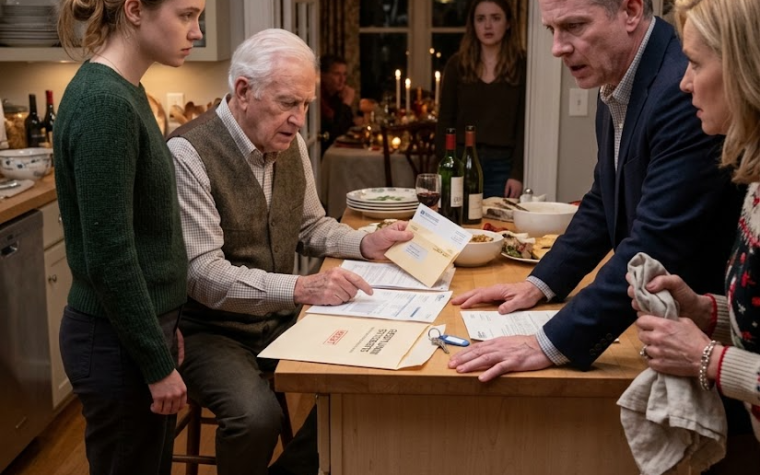
By afternoon, their tone changed.
The pregnant woman had apparently refused to stay with Adrian unless he proved he could provide a home.
He had moved into his parents’ house, where the sudden reality of an unemployed household guest and an approaching baby was far less romantic than the future they had imagined inside my three-story property.
Three days later, Lilibeth arrived alone.
I did not let her inside.
She stood beyond the gate holding a container of food, the same woman who had spent years criticizing my cooking and work schedule.
“Maria,” she said, “we all became emotional.”
“You seemed calm in the living room.”
She tightened her grip on the container.
“We were thinking about the child.”
“You were thinking about the house.”
Her face reddened.
“Adrian is suffering.”
“So was I.”
“He is still your husband.”
“Not for long.”
That was when she apologized.
The words came stiffly, almost resentfully, as though she were paying a fee she believed should purchase forgiveness.
“I’m sorry for how the conversation happened.”
Not for defending the affair.
Not for inviting the mistress into my home.
Not for trying to displace me.
She was sorry for how the conversation happened—because it had been recorded, because the deed had appeared, and because their plan had failed.
I declined the food and closed the gate.
The divorce took months rather than days.
Adrian initially challenged the ownership of the house, but the records were clear.
My mother’s payments, the gift documentation, and the title all supported the same truth: the property had been given to me and registered to me alone.
His lawyer eventually stopped pursuing the claim.
The recording also prevented Adrian’s family from presenting the living-room meeting as a friendly attempt at reconciliation.
Their own words showed that they had arrived expecting me to leave and intended to use the pregnancy, family pressure, and public embarrassment to force my cooperation.
Adrian changed strategies several times.
First, he was angry.
Then apologetic.
Then nostalgic.
He sent photographs from our wedding and messages about the man he used to be.
He reminded me of our early years, our first apartment, and the promises we made before anyone had betrayed anyone.
For a few nights, those messages hurt.
I remembered the gentle man who brought soup when I was sick, waited outside the bank after late shifts, and told my mother he would protect me.
But memory is not evidence of character.
It is evidence of a moment.
The man asking to return was the same man who had watched silently while his family tried to remove me from my mother’s house.
I never answered.
His relationship with the pregnant woman did not survive the pressure.
I learned through the legal proceedings that she ended it before the divorce was finalized.
Adrian accused her of caring only about money.
She accused him of promising a life he did not own.
Their accusations did not concern me.
The child was born healthy, and Adrian remained responsible for the consequences of his choices.
I did not celebrate his difficulties.
I simply refused to carry them.
When the divorce was finalized, I walked out of the lawyer’s office holding the same folder I had opened in the living room.
The deed was still inside.
So was my mother’s letter.
That evening, she came to visit.
She had known only part of what happened because I had not wanted to frighten her before everything was secure.
We sat at the dining table where I had poured the glass of water during the confrontation.