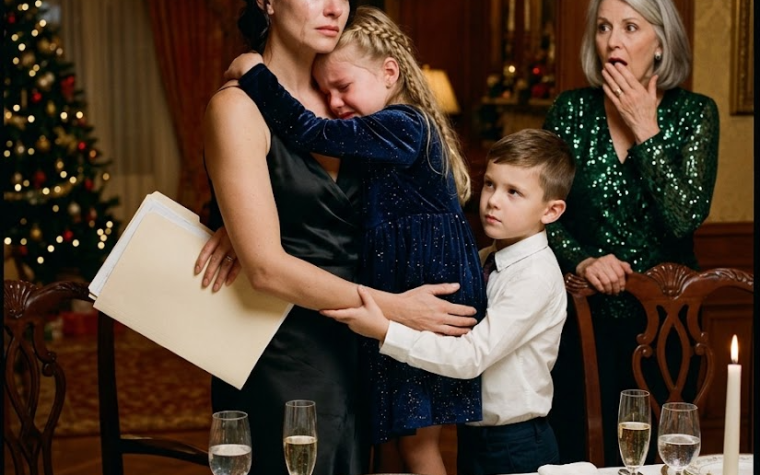
“We had nowhere else to go.”
“Neither did I.”
She covered her mouth.
My father placed the folder back on the table.
“You would send your own parents to prison?”
“I reported an attempted fraud.
What happens next depends on the evidence and what you do with the truth.”
He looked toward Vanessa, expecting support.
She moved beside me instead.
That was the moment he finally understood that he had lost control of both daughters.
I opened the front door.
“You need to leave.”
My mother paused beside me.
For one second, I wondered whether she might apologize.
She looked at the scar visible beneath my sleeve.
Then she said, “You always were unforgiving.”
I did not answer.
I closed the door after them and turned the lock.
My knees began shaking only when the deadbolt clicked.
Vanessa stood in the center of the room, unsure whether she had permission to move.
“I’ll go too,” she said.
I sat on the sofa.
“Not yet.”
She looked at me carefully.
“I don’t know what happens between us,” I told her.
“One warning and one apology do not make us sisters again.”
“I know.”
“But you told the truth when it cost you something.”
She nodded.
“That matters.”
The lender canceled the application before any money changed hands.
My credit remained intact, though I froze it for months and replaced every identifying document my parents might still possess.
The fraud investigation moved more slowly.
My father initially claimed I had authorized him verbally.
The recording ended that defense.
The messages Vanessa preserved established that the loan was never intended for tuition.
Faced with the application, the bank instructions, and his own admission, he accepted a plea agreement on forgery and attempted identity theft charges.
He received probation, community service, and restitution for the legal and investigative costs.
My mother avoided a separate conviction by cooperating, though the evidence showed she had helped collect my personal information.
They sold the house within the year.
For months, mutual relatives sent me messages accusing me of destroying the family.
Aunt Rachel answered one of them before I could.
“She did not destroy anything,” she wrote.
“She stopped them from destroying her twice.”
Vanessa did not enter the prestigious business school.
She moved out of our parents’ home, postponed her wedding, and found a job with a small accounting firm.
She began therapy.
Every few weeks, she sent me a message without demanding a response.
Sometimes she apologized for a specific memory.
The cup she knocked toward my left hand.
The word cursed.
The wave from the kitchen table.
I answered only when I had something honest to say.
A year later, she told me she had been accepted into a part-time program at a state university.
She planned to work during the day and pay what she could.
She did not ask me for money.