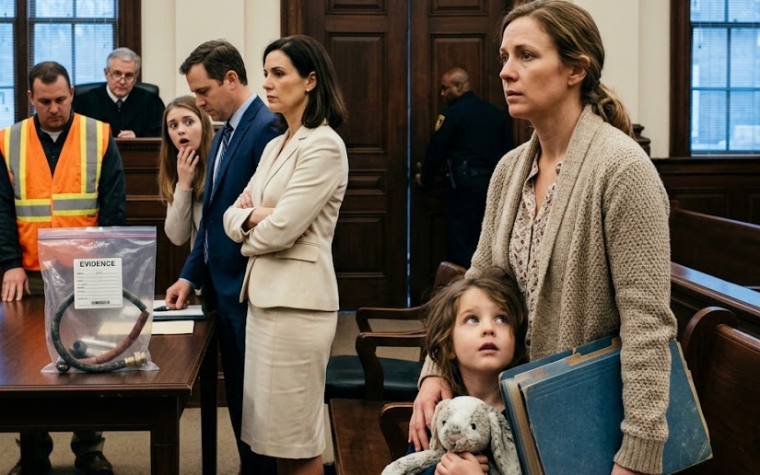
I opened the folder slowly.
Grant’s gaze dropped to the first page, but from his side of the boardroom table he could not read the smaller print.
He could only see the company seal, the signature blocks, and my hand resting calmly above them.
Diane remained standing.
“This is absurd,” she said.
“Elena has no authority to be in this room.”
The general counsel closed the door behind the security officer and took the empty chair to my right.
“Mrs.
Whitmore,” he said, addressing Diane without warmth, “please sit down.”
Diane blinked.
People did not speak to her that way.
Not assistants, not waiters, not department heads, and certainly not lawyers whose firms depended on corporate retainers.
Richard touched her arm.
She pulled away from him but lowered herself into the chair.
Grant looked from the lawyer to me.
“What is this?” he asked.
I turned the folder so the first page faced him.
It was a certified ownership summary showing the voting structure of Asteron Holdings, the private multi-billion-dollar corporation that had financed Whitmore Global’s expansion, licensed its most profitable technology, guaranteed two of its credit facilities, and approved the annual compensation packages of its senior executives.
At the top, beside the line marked controlling beneficial owner, was my full legal name: Elena Sofia Maren.
Grant read it once.
Then again.
His lips parted, but no sound came out.
Vanessa leaned over his shoulder.
“That must be another Elena.”
“It isn’t,” I said.
Diane snatched the page from Grant and scanned it.
Her face hardened instead of paling.
Denial came more naturally to her than fear.
“This is fabricated,” she said.
“Elena could not own Asteron.
She did not even have a proper family when Grant found her.”
“When Grant met me,” I replied, “Asteron had already operated for nine years.”
The general counsel slid several more documents across the table: incorporation records, trust distributions that had transferred full control to me, board resolutions bearing my authenticated signature, and confidential partnership agreements Grant himself had referenced in executive presentations.
My identity had been shielded through lawful holding structures because I preferred running the company without becoming a public spectacle.
The directors knew.
Our regulators knew.
Our banks knew.
Grant and his family had never known because none of them had possessed enough authority to access the ownership file.
They had mistaken restricted information for nonexistent information.
Richard picked up one of the partnership agreements.
His hand began to tremble.
“This signature,” he said.
“E.
Maren.”
“Mine,” I answered.
He looked at Grant.
“You told us Maren was an elderly European investor.”
Grant’s voice was strained.
“That was what people assumed.”
“No,” the general counsel said.
“That was what you repeatedly claimed without verification.”
Diane pushed the papers away.
“Even if this performance is real, it has nothing to do with a private family dinner.”
“It became a corporate matter before the water touched me,” I said.
I placed my phone on the table.
Grant’s eyes fixed on it.