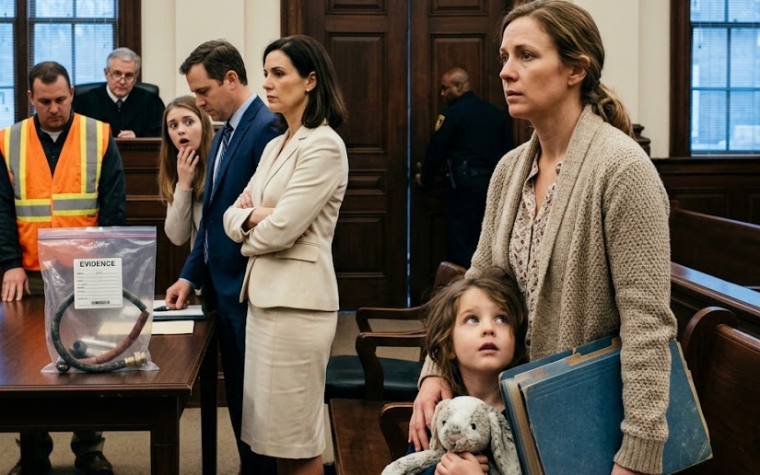
Lydia’s company closed.
My parents sold their house to satisfy debts and legal costs.
None of those consequences came from revenge.
I did not ask the prosecutor to be harsher, and I did not ask for mercy.
I simply stopped rescuing them from what they had chosen.
They sent letters through their attorneys.
My mother wrote that family should forgive.
Lydia wrote that Grandpa’s survival proved no real harm had been done.
My father never apologized.
He wrote only that I had humiliated him publicly.
I kept the letters in the blue folder.
Not because I planned to reread them, but because Grandpa had taught me that evidence matters when memory begins trying to soften the truth.
His recovery took eight months.
He learned to walk longer distances with a cane.
He complained about the bland food, flirted shamelessly with his physical therapist, and treated every medical restriction as an opening bid in a negotiation.
The first time he returned home, he stood in the doorway for almost a minute with one hand on the frame.
“I thought I’d never see this place again,” he said.
I steadied his arm.
“You’re not getting rid of me that easily.”
He glanced at me.
“That was my line.”
The $990,000 paid for surgery, rehabilitation, home nursing, and the changes his house needed.
The remaining money stayed in an account no member of my family could access.
I replaced every password, closed every outdated authorization, and built boundaries that did not depend on anyone’s promise to behave.
One evening, Grandpa and I sat on his porch while the sun lowered behind the trees.
He held out the brass pocket watch.
“You should keep this,” he said.
“It’s yours.”
“It did its job for me.”
I took it and opened the back.
The hidden compartment was empty now.
The key remained with the bank, and the original documents stayed protected in the box.
“I used to think the lesson was about time,” I said.
“It is.”
“I thought it meant not wasting it.”
Grandpa watched the second hand move.
“It also means knowing when someone has already taken enough of it.”
For most of my life, I had waited for my parents to choose me.
I had mistaken endurance for loyalty and silence for peace.
In the ICU, while they waited for an old man to die and expected me to sign away their betrayal, that waiting ended.
Grandpa survived because the transfer failed, the surgeon acted, and a handful of people refused to let cruelty disguise itself as family authority.
But I survived something too.
I stopped measuring my worth by what my parents were willing to give me.
The watch ticked between us in the evening quiet.
It still caught for half a second at the same tiny mark, then pushed forward.
So did I.