She stood in the living room near Dad’s chair, gripping its worn leather back.
“This was my home too,” she said.
Her voice had changed.
The command was gone, leaving something smaller beneath it.
“I know.”
“I took care of your father long before he became sick.”
“I know that too.”
“Then why would he do this?”
I looked at the envelope in my hand.
There was only one way to answer.
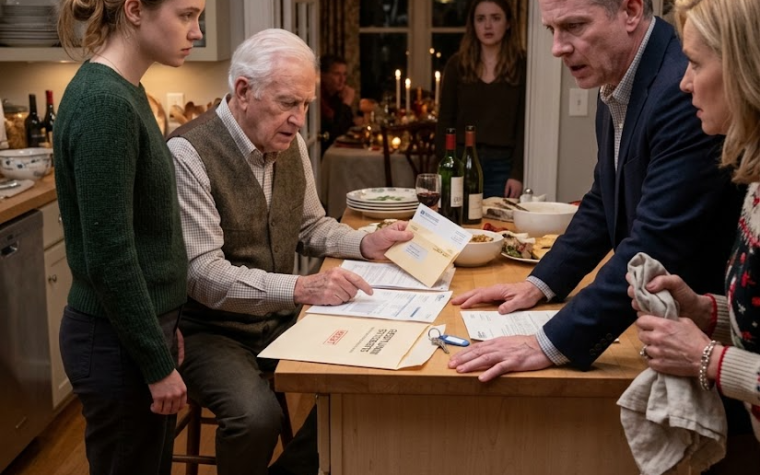
I opened Dad’s letter.
His handwriting grew shakier near the bottom, but the words were clear.
He wrote that he loved all of us.
He wrote that Mom had always believed a house represented security, while Kendra believed it represented status.
He feared that after his death they would fight over it, borrow against it, or sell it before the remaining debts were settled.
Then he wrote about me.
He listed the mortgage payments I had quietly covered.
The roof repair.
The hospital bills I had organized.
The nights I had slept in a chair beside him.
He said I never demanded repayment and never asked what I would receive.
The final paragraph broke something open inside me.
The house is yours, Ava.
Not because love should be paid back, and not because your sister deserves less love.
It is yours because you are the one who kept it standing when everyone else assumed it would stand by itself.
Make it a home, sell it, or walk away from it.
But let the choice finally be yours.
I read that part aloud.
Mom lowered herself into Dad’s chair.
For several moments, she said nothing.
Then she whispered, “He made me sound selfish.”
“He was afraid of what would happen.”
“He should have spoken to me.”
“Maybe he tried.”
Her eyes met mine, and I saw that she remembered something she did not intend to share.
Later, I learned Dad had mentioned putting the property in my name.
Mom had dismissed it as medication-induced confusion and changed the subject.
She had never checked whether he followed through.
Now the result sat between us in his handwriting.
Mom’s thirty-day notice remained in effect.
I did not force her out that afternoon.
I allowed her time to pack, find an apartment, and decide what she wanted to keep.
I paid none of her moving expenses, but I did not obstruct her either.
Kendra and Mark removed their boxes before sunset.
Their attorney contacted Maya two days later, then withdrew any threat of challenging the deed after reviewing the county record, the notary’s log, and Dad’s attorney’s file.
There was no missing signature, no secret defect, and no evidence Dad lacked capacity.
There was only a decision they disliked.
Mark’s insurance eventually paid for the items damaged on the lawn.
The ceramic bowl could not be restored perfectly, but a local artist repaired it with thin lines of gold-colored resin.
The cracks remained visible.
I preferred it that way.
Mom moved into a small apartment across town.
Kendra helped her, though their relationship never fully recovered from the accusations exchanged in my driveway.
For several months, neither of them spoke to me except through Maya.
The silence hurt, but it was cleaner than the cruelty that had come before it.
I changed the locks after Mom moved out.