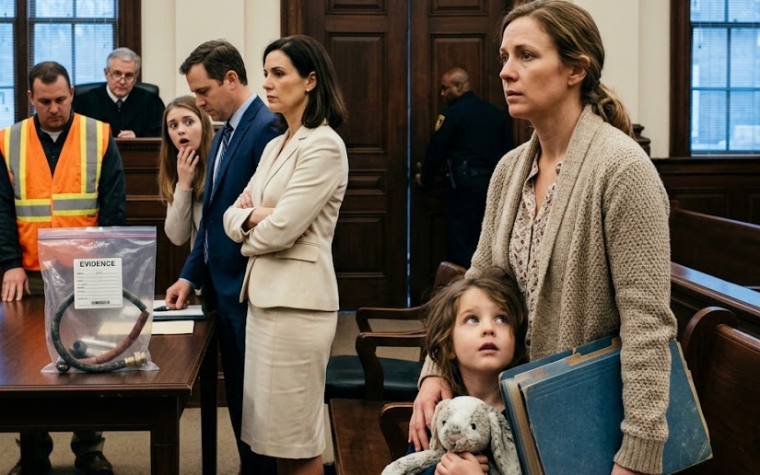
I had never agreed to transfer my house.
And unlike years of private conversations between husband and wife, my ownership was documented independently.
The paper trail did not care who was more persuasive in an argument.
It did not care who raised his voice.
It did not care who told Delilah she was bad with money.
It recorded dates, applications, accounts, signatures, and ownership.
The house became inaccessible to Evan’s plan in the way he had apparently expected to use it.
The disputed financial activity was reviewed account by account, and Delilah began the long process of challenging debts and accounts she said had been opened without her authorization.
It was not instant.
There was no magical morning when every number disappeared.
She had to answer questions repeatedly.
She had to identify signatures that were not hers.
She had to provide identification, records, dates, and statements.
She had to revisit humiliating moments from her marriage and explain why she had not known what was happening sooner.
But now there was a difference.
Every question moved the truth into the open instead of burying it.
The investigation into Evan and his mother’s conduct expanded around the documents, particularly the questioned loan applications, identity information, and attempted property transfer.
They could no longer solve the problem by pressuring Delilah into one more signature.
And they could no longer use the house as leverage over her.
I made sure of that.
The first time Delilah returned there after the parking lot, she did not go alone.
She was there to recover belongings for herself and Noah while the ownership dispute and investigation were being handled through proper channels.
She stood outside the three-bedroom house where she had spent five years trying to be a good wife and mother.
For a moment, she could not reach for the door.
I stood beside her.
“You don’t have to prove anything today,” I said.
She nodded.
Then she walked inside.
Noah’s room was almost exactly as he had left it.
His books were still on the shelf.
A small jacket hung behind the door.
Delilah picked up a second stuffed dinosaur that had been left on his bed and held it against her chest.
That was when she cried.
Not when she saw the debt total.
Not when she found my forged signature.
Not when Evan called her dramatic.
She cried in her son’s bedroom because a five-year-old had been made to believe that sleeping in a car might be his new normal.
We packed his clothes first.
Then hers.
The material things mattered less than the fact that she was finally choosing what belonged to her instead of accepting Evan’s definition of it.
The legal and financial consequences continued after that day.
The challenged accounts were examined, the questioned documents remained part of the investigation, and Evan and his mother had to answer for records that could no longer be hidden inside a marriage.
I will not pretend the damage vanished because the truth came out.
Delilah’s credit did not repair itself overnight.
Trust did not return simply because she understood how it had been broken.
There were forms, interviews, disputes, legal meetings, and long evenings when she sat at my table trying to separate what she had chosen from what had been chosen in her name.
But gradually, something changed.
She started opening her own mail.
She learned every account connected to her identity.
She kept copies of everything.
She asked questions without apologizing for them.
When someone used financial language she did not understand, she no longer assumed that meant she was foolish.
She asked them to explain it.
And if the explanation did not make sense, she asked again.
Noah changed too.
For the first few nights at my house, he kept his little sneakers beside the couch where he slept, as if he needed to be ready to leave quickly.