Then one morning I noticed they were gone.
I found them near the front door with everyone else’s shoes.
That small thing nearly broke me.
He had stopped preparing to run.
Months earlier, if you had asked Delilah who held the power in her marriage, she probably would have said Evan.
He controlled the accounts.
He controlled the information.
He decided what she was allowed to understand.
He had even convinced her that he could throw her out of a house and declare everything inside his.
But power built on secrecy has one weakness.
It depends on the secret surviving.
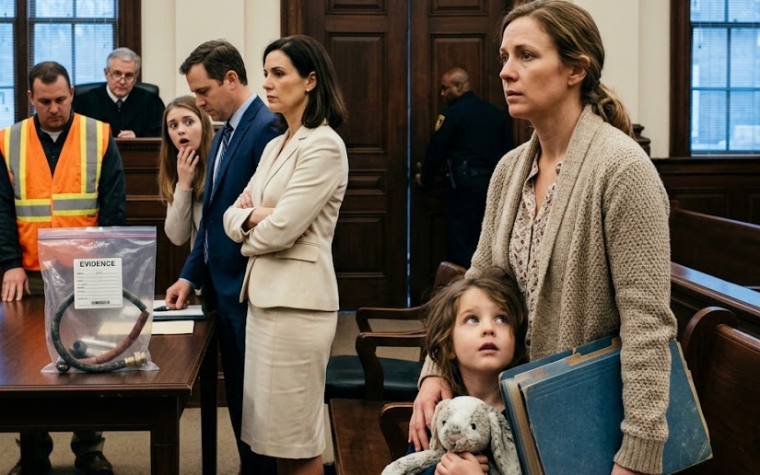
The moment Delilah carried that folder out of the house, the secret began to die.
The moment she placed it on my kitchen table, it stopped being only her word against his.
There were bank statements.
Applications.
Credit records.
Property documents.
Signatures.
And finally, one signature that belonged to me in appearance only.
Evan had apparently believed that piece of paper would help him take control of my house.
Instead, it became one of the clearest reasons everyone started looking more closely.
I often think about that morning in the grocery store parking lot.
If I had driven a different route, I might not have seen the faded blue sedan.
If I had been looking at the traffic instead of the edge of the lot, I might have passed them.
But I did see them.
I saw my daughter asleep against the driver’s-side window.
I saw my grandson under a worn blanket with his dinosaur tucked beneath his arm.
And I heard him ask whether he would sleep somewhere warm that night.
That question became the line I could never uncross again.
Evan thought throwing Delilah out would make her desperate enough to sign whatever he put in front of her.
Instead, it put her in the path of the one person who still legally owned the property he was trying to control.
He believed she had nowhere to go.
He believed nobody knew what had been happening.
He believed a frightened woman with two bags and a five-year-old child was powerless.
But Delilah had taken one thing with her that mattered more than anything she left behind.
The folder.
The evidence.
And once those papers were opened, the story he had spent years building around her could no longer survive untouched.
The greatest change was not the house, the accounts, or even the investigation.
It was the afternoon I watched Delilah sit at my kitchen table months later with a new stack of financial papers in front of her.
For a second I remembered the woman who had sat in the same chair saying she was bad with money because her husband had told her so often enough that she believed it.
This time she read every page.
She made notes in the margins.
She asked questions.
Then she signed only where she understood exactly what her signature meant.
When she finished, she placed the pen down and looked toward the living room, where Noah was laughing.
The sound filled the house.
No fogged windows.
No parking-lot lights.
No little sneakers waiting beside a back seat.
Delilah looked at me and said quietly, “I can’t believe I thought I had nothing.”
I looked at the folder that had once terrified her.
“You had the truth,” I said.
This time, nobody was going to take it from her.