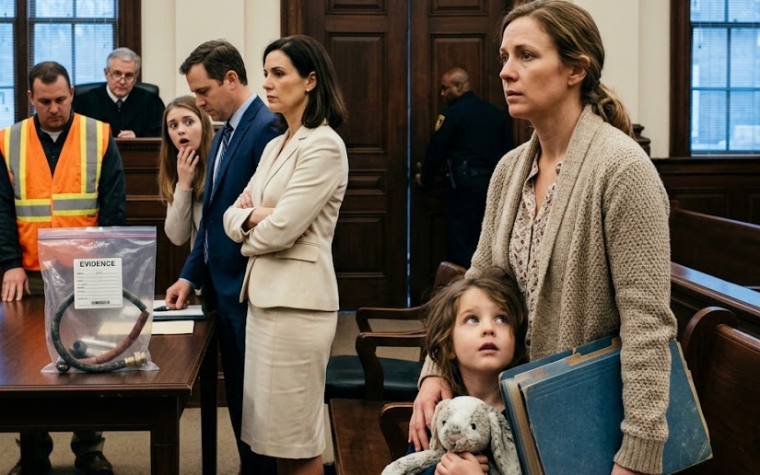
The folder opened with a soft crack that seemed louder than anything else in the courtroom.
Judge Judith Ramsey studied the certified deed Miriam had placed before her.
Brielle’s attorney leaned toward the bench, trying to read it from a distance.
Everett’s fingers remained suspended above his leather folder.
The judge turned another page.
“According to the county recording,” she said, “the Lake Whatcom property was conveyed to the Cedar Haven Trust six years ago.”
Dalton Pierce stood.
“Your Honor, my clients were never informed of any trust.”
“That does not alter the public record,” Judge Ramsey replied.
She looked at me.
“Ms.
Whitaker, did you create this trust?”
“Yes, Your Honor.”
Brielle twisted in her chair.
“She never told us.”
The judge did not look at her.
“Mrs.
Ashton, your attorney will speak for you unless I ask you a question.”
Brielle pressed her lips together.
Six years earlier, I had walked into Miriam’s office carrying the deed to the first home that had ever felt entirely mine.
By then, my parents had already begun calling the house a family asset whenever Brielle wanted something from me.
First, they wanted me to host every holiday.
Then they wanted me to let Brielle use the property for events.
After Everett began discussing investments, they suggested I borrow against the house so he and Brielle could pursue an opportunity they described as safe.
I refused.
My mother accused me of caring more about property than family.
My father said nothing.
Brielle cried, then stopped crying the moment she realized tears would not change my answer.
That was when I understood that owning the house personally left it vulnerable to years of pressure, manufactured emergencies, and documents presented as harmless family arrangements.
With Miriam’s help, I created the Cedar Haven Trust and recorded the transfer properly.
The trust preserved my right to live in the home, but any sale or change in ownership required formal approval under its terms.
A casual agreement bearing my personal signature could not transfer the property.
I had told no one in my family.
Judge Ramsey examined the sealed trust excerpt.
“Counsel,” she said to Dalton, “the document your clients seek to enforce purports to transfer property Ms.
Whitaker did not own in her individual capacity on the date stated.”
Dalton adjusted his glasses.
“The agreement could still reflect an obligation to direct the trust to transfer the property.”
“Not if she did not sign it,” Miriam said.
The judge raised one hand.
“We will reach the signature.”
She returned to the sealed pages.
My mother leaned toward my father.
“Did you know about this?”
He shook his head.
Brielle looked back at them.
“It’s probably something Laurel created after she promised me the house.”
Miriam rose.
“The county stamp shows the deed was recorded six years ago.
The alleged family agreement is dated two years ago.”
The courtroom became still.
Everett whispered something to Dalton.
Dalton’s jaw tightened.
Judge Ramsey read further, and the next part of my secret entered the record.
The Cedar Haven Trust did more than protect my ownership.
It named my parents as contingent residential beneficiaries.