The obligation was imposed on both of them, meaning neither could escape by blaming the other.
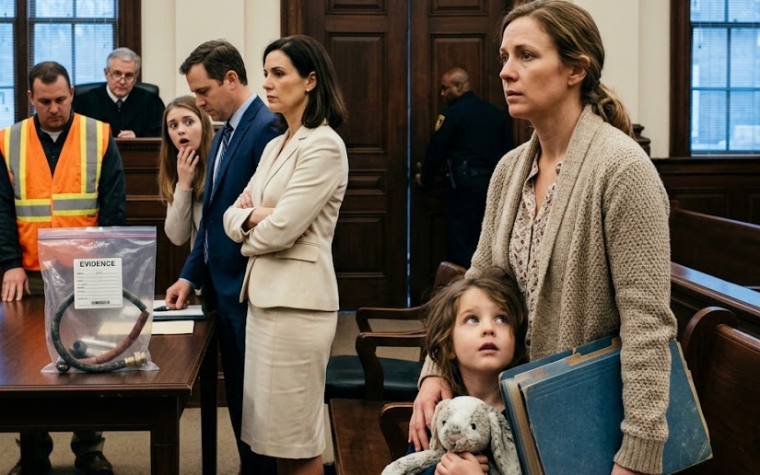
The judge instructed the clerk to preserve the original agreement, the electronic report, and the transcript as court exhibits.
She also ordered that copies be provided to the county prosecutor for review.
She made one point clear: the hearing was civil, and she was not deciding criminal guilt.
But the evidence raised questions that another office had the authority to investigate.
No one was dragged away in handcuffs.
There was no theatrical arrest.
There was something more believable and, for Brielle, more frightening.
A permanent court record now described exactly what she and Everett had done.
The case was dismissed with prejudice.
They could not simply revise the document and file again.
Judge Ramsey struck the gavel once.
Brielle remained seated after everyone else stood.
Her cream-colored suit looked as immaculate as it had when she arrived, but the woman wearing it no longer looked untouchable.
Outside the courtroom, my mother caught up with me near the stone steps.
“Laurel, why didn’t you tell us about the trust?”
I stopped.
“Because you would have called it a family asset.
Brielle would have called it an opportunity.
I wanted you protected without turning my home into another argument.”
Tears filled her eyes.
“All these years, I thought you kept everything for yourself.”
“You never asked what I was carrying.
You only asked what I could give Brielle.”
My father joined us.
He looked older than he had that morning.
“I should have told you she asked me to sign that page,” he said.
“Yes,” I answered.
“You should have.”
“I thought staying quiet would keep the family together.”
“Your silence kept Brielle comfortable.
It did not keep the family together.”
He nodded because there was nothing honest he could say against that.
Brielle and Everett emerged with Dalton several minutes later.
Brielle’s eyes found our parents first.
“Mom, you know I would never have put you out of that house.”
My mother looked at her as though she were seeing a stranger.
“It was not your house.”
Four words accomplished what thirty-four years of arguments never had.
Brielle’s expression twisted.
“So now everyone is on Laurel’s side?”
“This is not about sides,” my father said.
“You forged her name.”
Everett muttered, “Nothing has been proven criminally.”
Dalton turned on him.
“Do not say another word without separate counsel.”
Brielle stared at me.
For a moment, I expected another insult, another accusation, or another demand that I fix the consequences she had created.
Instead, she asked, “Are you really going to make us pay all those fees?”
I looked at her calmly.
“The judge made that decision.”
“You could waive them.”
There it was—the old expectation that even after trying to steal my home, she could still make her problem my responsibility.
“No,” I said.
I walked away before my parents could ask me to reconsider.
The investigation that followed moved slowly, as real investigations often do.