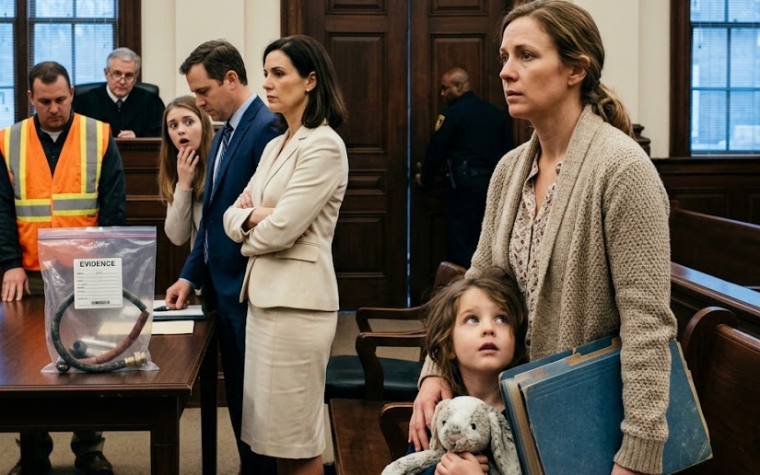
The judge turned to my father.
“Mr.
Whitaker, your name appears in the plaintiffs’ disclosures as someone with knowledge of the alleged family settlement.
Were you present when your daughter signed this agreement?”
My father stood slowly.
“No, Your Honor.”
“Did Ms.
Whitaker ever tell you she intended to give the house to Mrs.
Ashton?”
“No.”
Brielle twisted toward him.
“Dad.”
He looked at her for the first time that morning.
“You asked me to sign a witness page,” he said.
“I refused.”
My mother stared at him.
“You never told me that.”
“I should have.”
Brielle’s voice sharpened.
“You said you would stay out of it.”
My father’s shoulders dropped.
“That was my mistake.”
He explained that Brielle had visited him weeks before the lawsuit and asked him to sign a page confirming that the family had discussed transferring my home.
He had told her he could not confirm something he had never witnessed.
She had warned him that refusing would create conflict.
Then she told him not to worry because Everett had other proof.
My father had stayed silent because silence was what he always chose when Brielle pushed too far.
That morning, staring at the courtroom floor, he had not been uncertain about my signature.
He had been ashamed.
Judge Ramsey allowed him to sit.
My mother looked from him to Brielle, then to me.
For once, she had no quick defense ready.
The judge reviewed her notes for several long moments.
When she spoke again, every trace of patience had vanished from her voice.
“The court finds that the purported transfer agreement is not authentic.
The signature attributed to Ms.
Whitaker was reproduced from another document.
The notarial information is chronologically impossible.
The electronic file was created shortly before this litigation, despite bearing an earlier date.”
Brielle began to cry.
They were not the controlled tears she had used throughout our childhood.
Her breathing became uneven as the certainty she had carried into court disappeared.
Judge Ramsey continued.
“Even if the document were genuine, it would not accomplish the transfer claimed by the plaintiffs.
The property was held by the Cedar Haven Trust.
Ms.
Whitaker did not possess individual authority to convey trust property through this alleged agreement.”
Dalton stood.
“Your Honor, in light of the court’s findings, counsel requests permission to confer with the plaintiffs regarding dismissal.”
“The time for voluntary dismissal passed when your clients presented this document as genuine and requested judicial enforcement.”
Everett closed his eyes.
The judge declared the agreement void and unenforceable.
She granted the trust’s request confirming title, ordered the claim against the property removed, and directed that any notice clouding the deed be released immediately.
Then came the consequences Brielle had never imagined when she walked into court smiling.
Judge Ramsey found that Brielle and Everett had pursued the case in bad faith.
She ordered them to pay the attorney fees and forensic costs incurred in defending the property.