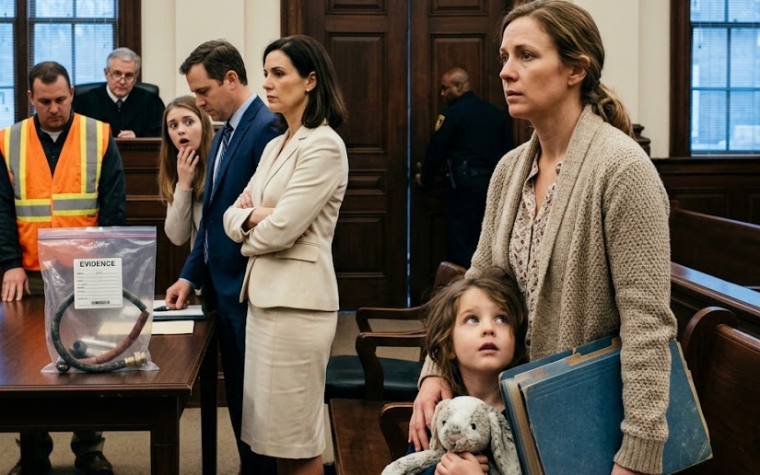
Several of Vanessa’s reports had been created before the appointments they claimed to document.
One described Ethan’s behavior during a session that had been canceled because he was sick at home with me.
Another recommended a medication increase thirty-six hours before Vanessa allegedly evaluated him.
The judge looked toward Vanessa.
“Did you write conclusions before examining the child?”
“No,” she answered.
“The timestamps may reflect administrative templates.”
My attorney displayed the document metadata.
The reports had not merely been templated early.
They had been completed, exported, and transmitted from a corporate server controlled by Adrian’s executive office.
Attached to several files were spreadsheets calculating how much money could be invoiced through each vendor without triggering an internal review.
Vanessa’s composure finally cracked.
“I had no control over Adrian’s accounting practices.”
It was the first time she had abandoned the respectful title she used in court.
Adrian glared at her.
My attorney noticed.
“So you acknowledge discussing the accounting practices with Mr.
Vale?”
“No.
That isn’t what I said.”
“You said you had no control over them.
That suggests you knew they existed.”
Vanessa turned toward the judge.
“I am pregnant.
This hostile questioning is causing unnecessary stress.”
The judge’s expression did not change.
“Your medical condition does not prevent you from answering whether you falsified a child’s psychiatric records.”
Vanessa looked at Adrian again.
This time, he looked away.
My attorney moved to Ethan’s medication history.
For months, Vanessa had described every unusual strength as a symptom.
When Ethan memorized a complex sequence after seeing it once, she called it rigid perseveration.
When he identified an error in a standardized test, she wrote that he resisted authority.
When he became drowsy and withdrawn after a dosage increase, she used the withdrawal as proof that his condition was worsening.
The pattern was visible only when every report was placed in chronological order.
Each time Ethan performed better than Vanessa predicted, the language in the next report became more severe.
Each severe report justified stronger medication.
Each medication invoice flowed through one of the numbered vendors.
The worse Ethan appeared, the more money moved.
After leaving the glass lounge, I had taken him to an independent hospital that had no relationship with Adrian or Vanessa.
A multidisciplinary team observed him while his medication was adjusted under proper supervision.
Their report found no evidence supporting forced residential placement.
They documented advanced pattern recognition, unusually strong numerical reasoning, medication-related sedation, and significant anxiety around the adults who had repeatedly described him as broken.
Vanessa had received that report before the hearing.
She had omitted it from her testimony.
My attorney handed her a copy of the delivery receipt.
“Did you read this independent assessment?”
Vanessa hesitated.
“I reviewed portions of it.”
“Did you inform the court that independent specialists rejected your recommendation?”
“I believed their evaluation was incomplete.”
“Did you disclose that your clinic received money through companies controlled by Mr.
Vale?”
“They were consulting payments.”
“For what consulting work?”
Vanessa opened her mouth.