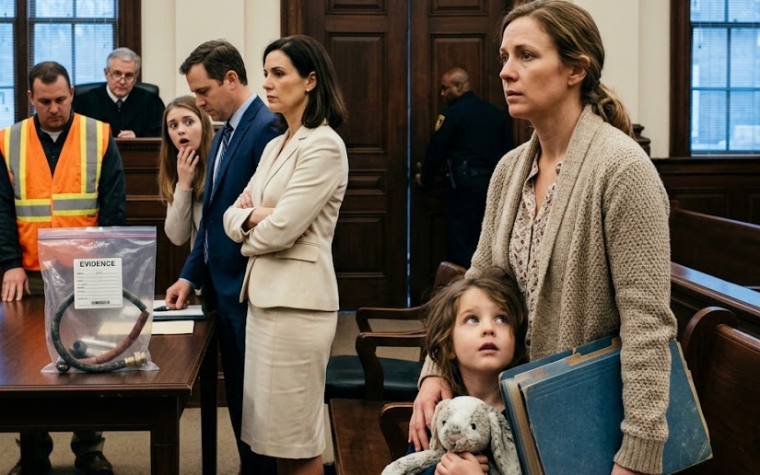
Nothing came out.
Adrian stood.
“This is absurd,” he snapped.
“She is doing this because I chose Vanessa.
Mara wants revenge, and she is using the boy to destroy me.”
The judge ordered him to sit.
He did not.
“I built that company,” he continued.
“Those transactions are private business matters.
She has no right to examine them.”
That sentence damaged him more than anything my attorney could have asked.
He had just claimed ownership of transactions his lawyers had spent twenty minutes describing as independent vendor activity.
My attorney waited until Adrian finally returned to his chair.
Then she displayed one paragraph from the corporate governance agreement.
Adrian had signed it eight years earlier during a major refinancing.
The agreement required immediate disclosure of any related-party vendor controlled by an executive, an executive’s household member, or a person with whom the executive maintained a personal relationship.
It also contained a mandatory suspension clause if the controlling executive concealed transactions or used company funds to falsify medical, insurance, or legal records.
Adrian had never read it.
He had simply signed beside the tab.
The board representatives in the back row were reading it now.
One left the courtroom without speaking.
The other began typing on his phone beneath the table.
My attorney introduced the final section of my report.
The shell vendors had not stopped at fraudulent medical invoices.
Money passed from the corporate accounts into a consulting network, then into two private trusts connected to Vanessa and a holding company used to purchase property for Adrian.
The transfers increased sharply during the months when Adrian was negotiating the sale of part of his company.
At the same time, he had offered me $250 million in exchange for signing a sweeping release that waived all future claims, disclosures, audits, and objections.
The offer had not been generosity.
It had been a deadline.
He needed my signature before the acquisition closed and before the undisclosed liabilities were examined by outside lenders.
My attorney displayed an email recovered from the discovery archive.
Adrian had written it to Vanessa two days before the meeting in the glass lounge.
Resolve Mara and the placement issue before closing.
Once she signs, the vendor trail becomes irrelevant.
Vanessa stared at the email.
Adrian’s attorneys asked for an immediate recess.
The judge granted twenty minutes and ordered every party to remain inside the courthouse.
During the recess, Adrian approached me in the corridor.
For the first time since I had known him, he looked smaller than the room around him.
“You don’t understand what you’re doing,” he said.
“Thousands of people depend on that company.”
“I understand exactly what I’m doing.”
“You’re burning down Ethan’s inheritance.”
“You called him defective and tried to lock him away.”
His eyes hardened.
“I was angry.”
“No.
You were organized.”
He glanced toward Ethan, who sat beside my attorney with a blank sheet of paper, drawing the number pattern he had seen in the exhibits.
Adrian lowered his voice.
“Withdraw the report.
I’ll increase the settlement.”
Even then, he believed there was a price.
I walked past him without answering.
When court resumed, the board representative returned with outside counsel.
The company had placed Adrian on emergency administrative suspension under the governance agreement.