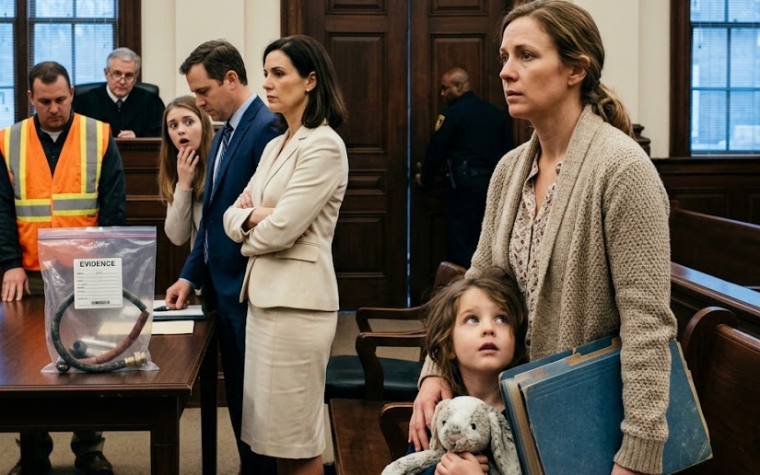
The acquisition had been paused.
The corporate banks had received preservation notices.
The judge emphasized that the family court was not deciding criminal guilt.
However, the evidence raised credible concerns involving falsified medical records, concealed related-party transactions, witness manipulation, and potential financial fraud.
She ordered the entire record preserved and referred copies to the appropriate licensing, regulatory, and prosecutorial authorities.
She also froze extraordinary transfers from the marital estate until ownership and liability could be determined.
Then she turned to the issue that mattered most to me.
Ethan would not be placed in residential care.
I received temporary sole legal and physical custody.
Adrian lost authority over Ethan’s medical treatment, and any future contact required professional supervision until the court completed a safety review.
Vanessa was barred from evaluating or treating him.
When the judge announced that order, Ethan did not smile.
He simply released the breath he had been holding and slipped his hand into mine.
Adrian watched him.
For one uncertain moment, I thought he might apologize.
Instead, he said, “You have no idea what that child just cost me.”
The judge heard him.
So did the court reporter.
So did the board’s outside counsel.
That sentence entered the official record.
The collapse did not happen with flames or sirens.
It happened through notices, frozen accounts, canceled meetings, withdrawn credit, and signatures from people who no longer trusted Adrian’s name.
Within seventy-two hours, the acquisition failed.
The board removed Adrian from all executive authority while an independent investigation examined the shell vendors.
Lenders invoked disclosure clauses he had ignored.
Several senior directors cooperated rather than risk being pulled into his decisions.
The company itself survived under temporary independent leadership, protecting most employees from the consequences of Adrian’s conduct.
His personal empire did not.
Properties held through the concealed companies were restrained.
Private accounts became evidence.
The voting control he had treated as permanent shifted under the fraud provisions he had never bothered to read.
Vanessa’s professional license was suspended on an emergency basis.
Investigators confirmed that she had altered evaluations, billed through undisclosed entities, and recommended treatment while maintaining a financial and romantic relationship with Ethan’s father.
She eventually admitted falsifying records in exchange for reduced charges, though she continued insisting that Adrian had designed the scheme.
Adrian insisted Vanessa had acted alone.
Their messages proved otherwise.
The divorce took nearly a year.
I did not receive the secret $250 million payment he had offered in the lounge.
I received something he had tried much harder to prevent: a lawful accounting of the marital estate, control of my own future, and a protected trust for Ethan funded from assets the court determined had been concealed.
Adrian faced civil judgments, regulatory penalties, and criminal charges connected to the financial scheme and the falsified records.
His lawyers stopped describing him as untouchable.
They began negotiating consequences.
Ethan’s recovery was quieter.
Without Vanessa controlling the narrative, he was allowed to be a child rather than a collection of symptoms.
He still disliked crowded rooms.
He still noticed patterns other people missed.
He still corrected errors with a directness that made some adults uncomfortable.
None of those things made him defective.
Independent specialists helped us understand his strengths, his stress responses, and the harm caused by months of unnecessary sedation.
Progress was not immediate, but his laughter returned in pieces.
One evening, several months after the hearing, I found him at our kitchen table with a box of inexpensive forks.
He built the same twelve-level structure he had made in the glass lounge.
One hundred forty-four pieces.
This time, nobody laughed at him.
When he finished, he studied the tower and asked, “Did Dad really think I was stupid?”
I sat beside him.