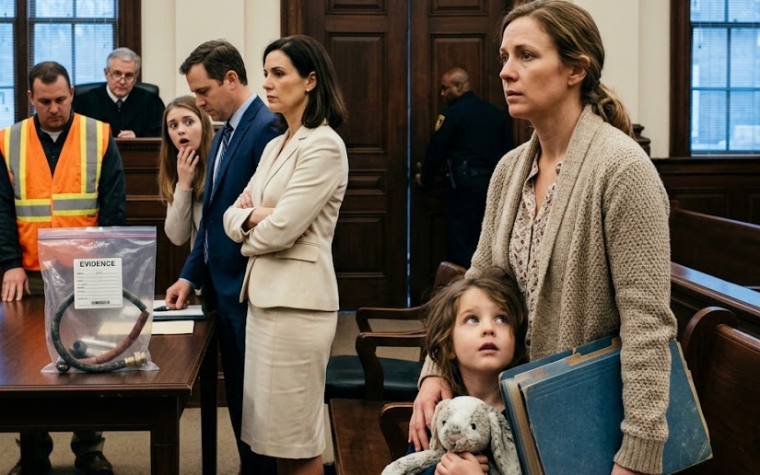
He learned which child hated peas, which one loved drawing, which one asked endless questions, and which one stayed quiet until trust arrived.
He did not demand to be called Dad.
He let them decide how close to come.
Watching him with them unsettled me more than anger ever had.
It forced me to confront the possibility that Victor had stolen something from Ethan too.
Not responsibility.
Ethan still had to answer for the choices he made and the trust he had placed in his father.
But Victor had built the wall between us higher than either of us knew.
When the test results arrived, Ethan asked me to open them with him.
Victor insisted on being present.
Perhaps he still believed numbers might rescue him.
I opened the report.
Four results.
Four confirmations.
Ethan Harrison was their biological father.
For several seconds, he did not speak.
He simply looked at the pages.
Then he sat down.
Victor remained standing.
His face emptied of expression.
The proof had removed his final defense.
Ethan looked up at him.
“They’re your grandchildren.”
Victor’s mouth moved, but no words came.
Ethan continued.
“You paid their mother to disappear before you knew they existed.
Then you spent five years making sure I believed she had abandoned me for money.”
“I was protecting the family.”
“No,” Ethan said.
“You were protecting control.”
Victor flinched.
It was almost imperceptible.
But I saw it.
Five years earlier, I had watched him celebrate a victory in silence.
Now I watched him understand what that victory had cost.
The consequences did not arrive all at once.
There was no single explosion that destroyed the Harrison empire overnight.
Reality was slower and more believable than that.
Ethan postponed every public commitment surrounding the wedding and withdrew from several decisions Victor expected him to follow without question.
He began examining parts of his life he had previously trusted his father to manage.
Their relationship changed immediately.
Not because Ethan stopped loving him, but because love without trust became something far more complicated.
Victor had spent decades believing power meant preventing uncertainty.
Now he could not control whether his own son would forgive him.
He could not control whether his grandchildren would ever want him in their lives.
And he could not control me.
That last truth seemed hardest for him to accept.
Weeks after the wedding, he asked to meet me alone.
I agreed.
We sat across from each other again, though not in his office.
There was no giant desk between us this time.
No check.
No contract.
Victor looked older than he had five years before.
For a while, he said nothing.
Then he asked, “Did you come to the wedding to destroy us?”