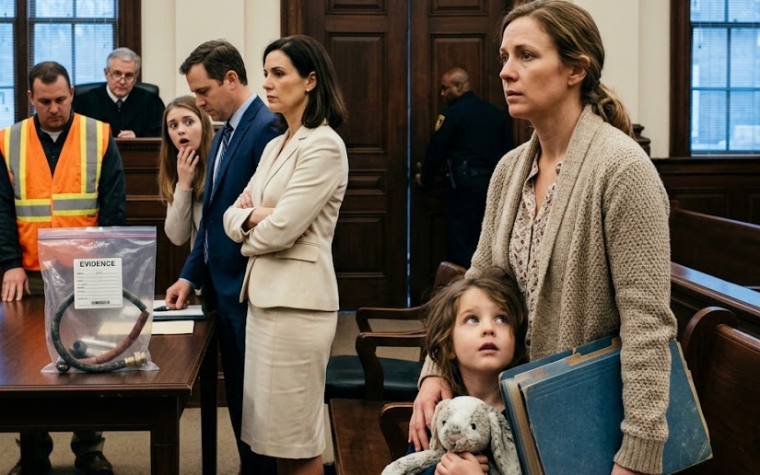
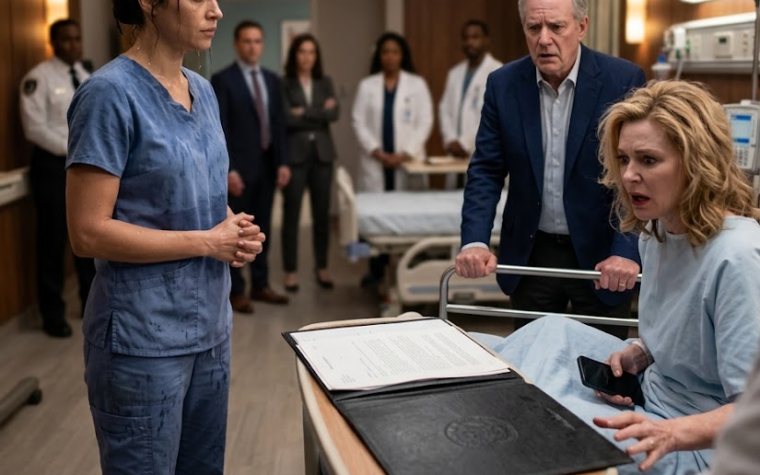
The sworn statement in Graves’s hand was the nurse’s account, preserved before anyone could persuade her to retract it.
Attached to it was evidence that money had been offered in connection with keeping the allegations out of any formal proceeding.
Ethan’s chair scraped.
“This is outrageous.
She’s using confidential clinic allegations to distract from a licensing complaint.”
Graves turned one page.
“The licensing complaint has no factual basis.”
Ethan went silent.
“So there is nothing from which to distract us.”
My mother’s breathing became audible.
Then Graves lifted the hospital garage photograph.
Even from across the room, I could see the moment Ethan recognized it.
His eyes went directly to my father.
The photograph showed all three of them together three nights before the hearing: Ethan, my father, and my mother.
Celeste was holding the red folder.
Beside them stood the tribunal’s records supervisor.
In the captured frame, the supervisor was handing my father an envelope.
That image mattered because the affidavit inside Ethan’s complaint packet said the supervisor had never communicated with my family outside official channels and had never handled documents concerning my licensing history before the complaint was filed.
The photograph said otherwise.
Ethan tried another angle.
“A photograph proves people were in a parking garage.
It doesn’t establish what was discussed.”
“No,” Graves said.
“It doesn’t.”
He opened the Attorney General’s appendix.
“This does considerably more.”
My father stood.
“Judge Graves, I am not a party to my daughter’s professional dispute.”
Graves looked at him.
“Sit down, Dr.
Pierce.”
My father remained standing for one heartbeat too long.
Then he sat.
The appendix had been prepared because I had forwarded the whistleblower records, the escrow trail, and the attempted registry manipulation through the proper channels before the hearing.
I had not known what the Attorney General’s office would conclude.
I only knew that the materials had been accepted for review and that I had been instructed not to disclose the existence of the appendix unless the licensing accusation was formally pursued.
Ethan had forced that condition himself.
He could have withdrawn the complaint.
He could have stopped after learning that my admission records were real.
Instead, he wanted the humiliation on the record.
So the record opened everything else.
Graves read slowly.
The appendix cross-referenced the whistleblower statement with the escrow transfers.
It identified the affidavit concerning the tribunal records as potentially false.
It documented preservation requests covering communications between Ethan’s firm, my father’s clinic, and the records office.
And it instructed the tribunal to preserve any original materials voluntarily introduced by the complainants if the disciplinary hearing proceeded.
Everyone looked at the red folder.
For the first time, my mother spoke.
“Ethan told us this was about correcting the record.”
My brother turned toward her so sharply that his chair shifted.
“Mother.”
Her face crumpled, but not into tears.
Into realization.
“You said Bella had been using a dead man’s number.”
“She was.”
“No,” Graves said.