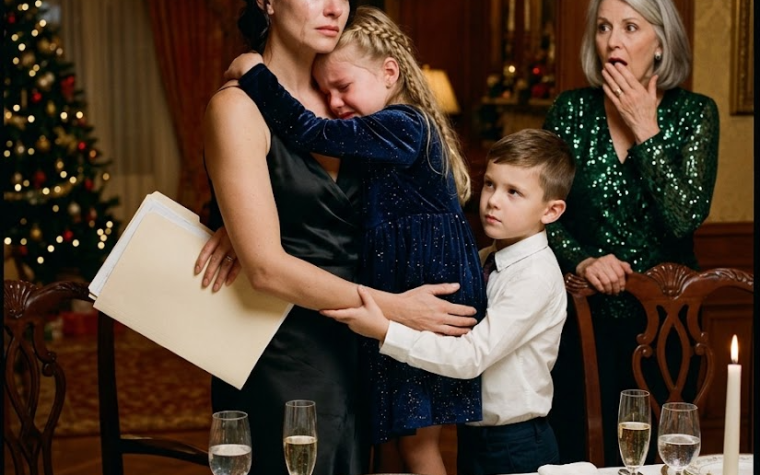
The wedding, the renovations, the investment property—you thought your followers were paying for that?”
Tiffany slapped him.
The sound cracked through the room.
Officer Ramirez stepped between them.
“No one touches anyone else.”
Brad’s mask finally came apart.
He accused Tiffany of planning the forgery.
Tiffany accused my parents of giving them access to the files.
My father blamed Brad for exploiting the family.
My mother began crying and said she had only wanted both daughters to have something.
I listened until the noise became useless.
Then I walked to my father’s office and opened the lower cabinet beneath the bookcase.
My grandmother’s photograph was inside, facedown beneath a stack of loan brochures.
I lifted it carefully.
The glass was cracked across one corner.
When I returned to the dining room, Detective Ortiz was reading Brad and Tiffany their rights.
The evidence supported attempted property fraud, forgery, conspiracy and filing a false police report.
The officers did not arrest my parents that night, but they collected their statements and warned them that further charges would depend on what the records showed.
Tiffany’s livestream ended when her phone was placed into evidence.
By then, more than twelve thousand people had watched her point the police at me and then expose her own plan.
The guests left quietly.
Some tried to apologize at the door.
I did not need apologies from people who had laughed only because the room had given them permission.
When the house was finally still, my father approached me.
“Are you throwing us out tonight?”
The trust allowed me to do exactly that.
Their attempt to transfer the property had terminated their right to remain.
I looked at my mother’s shoes beside the stairs, my father’s reading glasses on the desk and the family photographs arranged to suggest a closeness we had never possessed.
“You have thirty days,” I said.
“Margaret will put it in writing.
You may take your personal property.
Nothing belonging to Grandma leaves without an inventory.”
My mother looked at me through swollen eyes.
“Leah, please.”
“You called the police so Tiffany could steal my house.
Thirty days is mercy.
Do not mistake it for weakness.”
General Cole stood near the doorway, silent as he had promised my grandmother he would be unless I needed him.
This time, I did not.
The legal process lasted eight months.
The county court voided the forged transfer within days and confirmed the trust’s ownership.
Brad later pleaded guilty to felony forgery and attempted theft.
Investigators connected him to another fraudulent deed prepared for an elderly client.
His real estate license was revoked, and he received a prison sentence followed by restitution.
Tiffany pleaded guilty to conspiracy and filing a false report.
Because she had no previous convictions and cooperated after Brad’s other scheme was uncovered, she received supervised probation, community service and a restitution order.
Her online sponsors disappeared before her first court appearance.
My parents were not criminally charged.
The prosecutor concluded that they had acted dishonestly but had not understood Brad’s financing scheme or personally forged the documents.
Civilly, however, the result was clear.
Their occupancy rights were terminated, and they were required to repay trust funds they had diverted for cosmetic renovations unrelated to maintenance.
They moved into a smaller apartment across town.
For several months, my mother sent letters.
Most contained explanations.
A few contained blame.
The last one contained only six words.