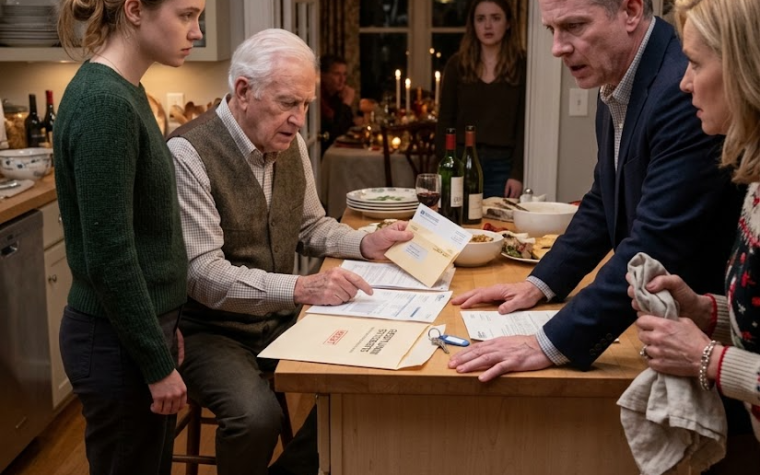
He looked toward his mother, but she had sunk back into her chair.
She was reading the board consent bearing her signature as if the ink might rearrange itself into innocence.
The guests began leaving in quiet groups.
Some avoided my eyes.
Others touched my shoulder or offered careful apologies that came too late to feel generous.
The senator paused beside me.
“I should have said something sooner.”
“Yes,” I said.
He nodded, accepting the answer, and left.
When the room was nearly empty, Grant remained beside the table.
The opened bottle stood between us.
Only one glass had been poured.
My father’s wine had not become a toast.
It had become evidence of a marriage that had ended long before I admitted it.
Grant reached for the bottle.
I moved it away.
“You do not get the rest.”
His expression hardened.
“What will you do with it?”
“I have not decided.”
That answer belonged to me too.
The forensic review lasted four months.
It uncovered repeated payments, altered expense descriptions, and transfers routed through Mercer Strategic.
Grant denied intending to defraud anyone, but the records showed that he had approved expenses for his private life while classifying them as donor development.
Under the settlement, he repaid the diverted funds, surrendered any claim to foundation leadership, and accepted full responsibility for the false filings.
The matter was referred to state authorities, and he later entered a plea requiring additional restitution and years of financial supervision.
His mother resigned from the board.
She sent me a letter explaining that she had signed because Grant told her the documents were routine.
She wrote that mothers sometimes protect their sons without understanding the damage they cause.
I returned the letter without answering.
Sloane cooperated with the investigation.
She provided messages in which Grant promised that he controlled the foundation, the house, and the family assets.
She repaid what remained in her company account and moved out of the condominium.
She and Grant did not stay together.
I did not celebrate that.
A child would still enter the world tied to the wreckage he created.
I asked my attorneys to ensure that nothing in the settlement interfered with his legal obligation to support that child.
Justice did not require cruelty to someone who had not yet been born.
The foundation survived.
Some donors left.
More stayed because we released the audit, corrected the failures, and replaced private loyalty with real oversight.
We created rules that no spouse, parent, friend, or famous name could bypass.
At the first board meeting after the investigation closed, I wore my mother’s diamond earrings.
They felt heavier than I remembered.
The empty wine bottle stood at home on a shelf in my study.
I had considered throwing it away.
Instead, I kept it—not as a monument to Grant, but as a reminder of the night I finally stopped confusing endurance with love.
Before the meeting began, the bishop asked whether I wanted someone else to open the session.
I looked around the table where no one would ever again be asked to confuse silence with manners.
Then I took my seat at the head.
“No,” I said.
“Let’s begin.”