“I said it once,” he muttered.
“Then you believed me.”
My mother stared at him.
“And when she came home?”
Tom said nothing.
“When she sent the wedding invitation?”
Nothing.
“When she sent us the baby’s picture?”
His jaw tightened.
Finally he said, “I didn’t know how to undo it.”
I had waited twelve years for an explanation.
That was all there was.
Not some elaborate conspiracy.
Not a reason powerful enough to justify what happened.
A lie, followed by cowardice, followed by twelve years of choosing the next easy silence.
My mother started crying.
Tom looked at me.
“I was going to tell them eventually.”
I thought about Emily growing from a yellow blanket into a school-aged girl while he waited for eventually.
I thought about Michael standing next to me in a chapel with two empty seats on my side.
I thought about Christmas cards addressed in my own handwriting.
“Eventually became twelve years,” I said.
He had no answer.
My parents asked whether they could see me before I left.
I did not give them instant forgiveness.
Twelve years does not disappear because the truth finally becomes embarrassing enough to acknowledge.
But I also did not punish them with a speech.
My mother apologized first.
Not for being fooled.
For choosing not to believe me even after I came home.
That distinction mattered.
My father apologized for the sentence he had thrown at me on the porch.
“I told you to finish what you started,” he said quietly.
“You did.
I was the one who didn’t see it.”
I felt something shift inside me, but it was not the relief I had imagined when I was twenty.
I no longer needed their belief to make my life real.
I had a husband who had watched me earn every promotion.
A daughter who knew exactly what her mother did.
Friends and sailors who had trusted me with work that mattered.
Twelve years of mornings when I put on the uniform whether my parents acknowledged it or not.
Their recognition arrived late.
My career had not.
Before leaving, my mother asked if Emily knew about them.
“She knows I have parents,” I said.
The answer hurt her.
It was supposed to be true, not cruel.
“Could we meet her someday?”
I looked at my father, then at my mother.
“Someday is something you earn one day at a time.”
Neither argued.
That was the first sign I saw that anything between us might actually change.
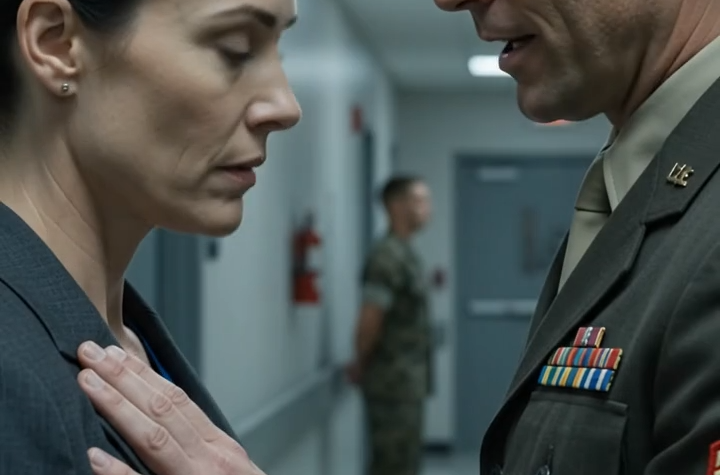
I walked out of the courthouse in the same dress whites that had shocked them hours earlier.
The evening light caught the ribbons over my chest.
For twelve years, I had imagined the day my family finally learned I had never failed.
When it arrived, the strangest part was realizing I no longer felt like the daughter waiting on the porch to be believed.