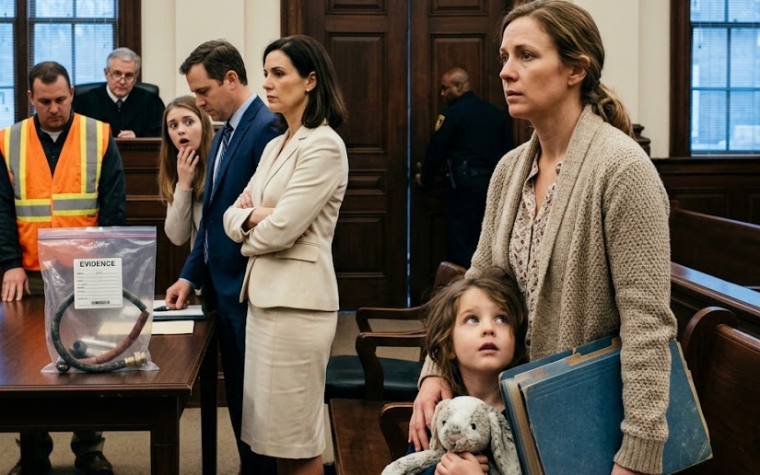
“That is not what I said.”
“Yes, it is.”
“Sit down.”
“You said she would interfere.” Victoria pointed at me.
“You said if we moved fast enough, the court would approve it before she could drag everything out.”
My heart stopped pounding.
For the first time all morning, I felt strangely calm.
They were doing something no document could have done as efficiently.
They were telling the truth by trying to blame each other.
The judge ordered Victoria to sit.
Then he addressed her attorney.
“Counsel, I assume you will want an opportunity to confer with your client before she makes any further statements.”
“Yes, Your Honor.”
“Request granted.
In a moment.”
The lawyer looked almost relieved.
The judge continued.
“But first, I am ruling on the emergency petition.”
Victoria went still.
My parents stopped whispering.
The judge looked down at the motion that had seemed so powerful thirty minutes earlier.
“The request for immediate transfer and full authority is denied.”
Victoria’s lips parted.
The judge kept speaking.
“This court will not grant sweeping control over disputed assets where material ownership information was omitted, where the petitioner’s factual representations are now contradicted by trust records, and where questions have been raised regarding the completeness of financial disclosures.”
My father shifted in his seat.
The judge added that no one was being declared guilty of misconduct in that moment.
The court was not making findings beyond what was necessary to stop an immediate transfer.
But the rush was over.
That mattered.
Victoria had entered expecting to leave with everything under her control.
Instead, the estate would remain protected while records were examined, the trust was properly accounted for, and the appropriate parties were identified.
The judge ordered that no disputed assets be moved outside normal authorized processes pending further review.
He also directed counsel to preserve relevant records and communications.
That phrase hit my father harder than the denial.
Preserve relevant records and communications.
He stared at the floor.
Victoria saw him.
“What did you do?” she whispered.
He didn’t answer.
The judge called a short recess.
The moment he left the bench, the courtroom erupted into low voices.
Victoria’s attorney pulled her toward the far side of the counsel table.
“You need to stop speaking immediately,” he told her.
“But she—”
“No.”
He pointed toward me without looking at me.
“She did not file your petition.
She did not supply me with the asset schedule.
She did not make the representations I just made to the court based on what your family gave me.”
Victoria’s face went white.
My mother hurried toward my father.
“What papers did they serve you?”
He stepped away from her.
“Not here.”
“You lied to me about the trust.”